
Most small businesses don’t fail because they’re not trying hard enough. They fail because everything they do in marketing feels disconnected.
They post on Instagram when they have time. They try running ads for a week. They publish a blog here and there. Nothing compounds. Nothing builds momentum. And after a while, it starts to feel like digital marketing is just noise.
The issue is not effort. It’s the absence of a system.
A proper digital marketing strategy is what turns scattered actions into a structured engine — one that consistently brings in traffic, builds trust, and converts that attention into leads and customers.
In this guide, I’m going to walk you through exactly how to create a digital marketing strategy from scratch. Not theory. Not frameworks you forget. But a practical, execution-focused process you can actually follow — using real tools, real decisions, and real constraints that small businesses deal with.
At this point, don’t overthink the entire process. Focus on understanding the structure first — because once you see how everything connects, execution becomes much simpler.
Table of Contents
What a Digital Marketing Strategy Really Means (Beyond Channels)?
Before we jump into steps, it’s important to reset how you think about “strategy.”
Most people assume a strategy is something like:
- “We’ll do SEO”
- “We’ll run ads”
- “We’ll post on social media”
That’s not a strategy. That’s a list of activities.
A real digital marketing strategy connects five things in sequence:
- Your business goal
- Your audience
- The channels you use
- The actions you take
- The results you measure
If those five aren’t connected, you’ll always feel like you’re doing work without seeing outcomes.
For example, posting daily on Instagram might look like effort. But unless you know why you’re posting, who you’re targeting, and what action you want from them, it won’t translate into business growth.
So as we go through this, keep asking yourself:
“Does this step move me closer to actual customers?”
That question will keep your strategy grounded.
Step 1: Define Your Business Goal (Start With Outcomes, Not Channels)
Everything begins here. And this is where most strategies quietly fail.
If your starting point is:
“I want more traffic”
you’re already too far removed from what actually matters.
Traffic is only useful if it leads to something measurable — leads, enquiries, or sales.
So take a moment and define your goal in concrete terms.
Open a document or spreadsheet and write this down clearly:
- What do you sell?
- What action leads to revenue? (form fill, call, checkout)
- How many of those actions do you want per month?
Let’s say you run a service business and your goal is 20 qualified leads per month.
Now think one layer deeper.
If your website converts at around 5%, you need roughly 400 targeted visitors to generate those 20 leads.
This simple calculation changes everything. You’re no longer chasing vague growth — you’re building a system that supports a specific number.
If you’re unsure about your numbers, start with a rough estimate. Even a simple target like “10 leads per month” is enough to begin. You can refine it later — what matters now is having a direction.
That clarity will guide every decision that follows.
Step 2: Understand Your Audience Using Real Search Behaviour
You don’t need a complicated persona framework. What you need is a clear understanding of how your audience behaves when they are looking for solutions.
The easiest place to start is Google.
Search your core topic — for example, “buy smart watch.” Look at the autocomplete suggestions, the “People also ask” section, and the titles of the top-ranking pages.
You’ll notice patterns quickly. People are asking things like:
- “Smart Watch rs 50”
- “Smart Watch rs 100”
- “flipkart smart watch”
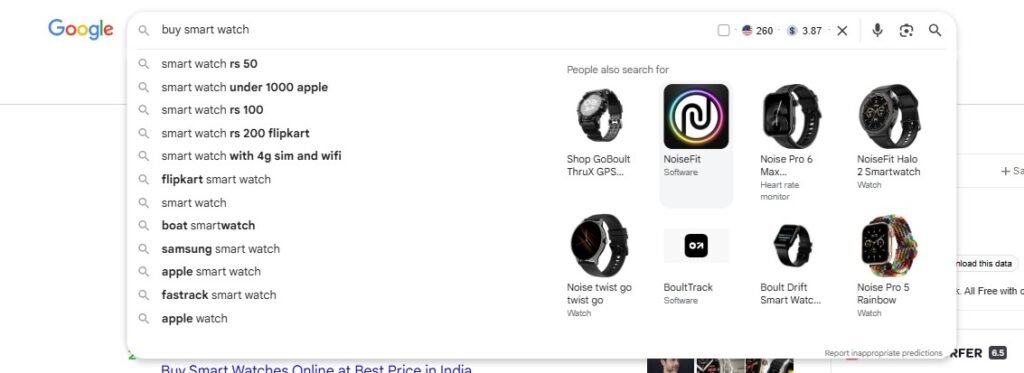
These are not just keywords. They are signals of confusion, intent, and decision-making stages.
Now move to a tool like Semrush or Ahrefs.
In Semrush, go to the Keyword Overview section and enter your primary keyword. Then open the Keyword Variations report and filter by questions or long-tail phrases.
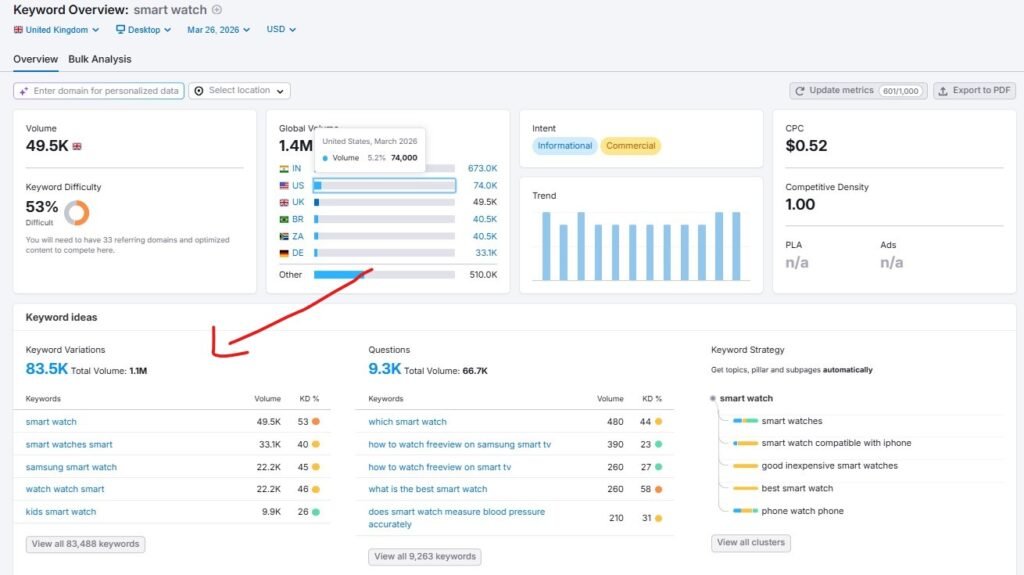
Look at terms that include words like “how,” “best,” “example,” or “template.” These usually indicate higher intent and clearer needs.
As you go through these, don’t just collect keywords. Ask yourself:
- What problem is this person trying to solve?
- Are they just learning, or are they ready to act?
From this, you can form a simple but powerful audience understanding:
They are likely beginners or small business owners who feel overwhelmed and are looking for a clear starting point.
That insight will shape how you communicate, what channels you prioritise, and how you structure your content.
By the time you finish this step, you should have a clear idea of what your audience is searching for. If not, go back and spend more time here — because every decision that follows depends on this clarity.
Step 3: Analyse Competitors to Find Gaps (Not to Copy Them)
Once you understand your audience, the next step is understanding what already exists in the market.
Search your keyword again and open the top five results.
Pay attention to how they structure their content. Most of them will follow a similar pattern — introduction, explanation, then a series of steps.
Now look deeper.
Do they show how to use tools like Google Analytics or Semrush? Do they explain how to actually implement each step, or do they stop at explanation?
You’ll notice something consistent. Most articles explain what a strategy is and list the steps, but they don’t walk you through execution in detail.
That’s your opportunity.
If you want to go further, use Semrush’s Organic Rankings tool. Enter a competitor’s URL and look at:
- Their top-performing pages
- The keywords those pages rank for
This helps you understand what topics drive traffic in this space.
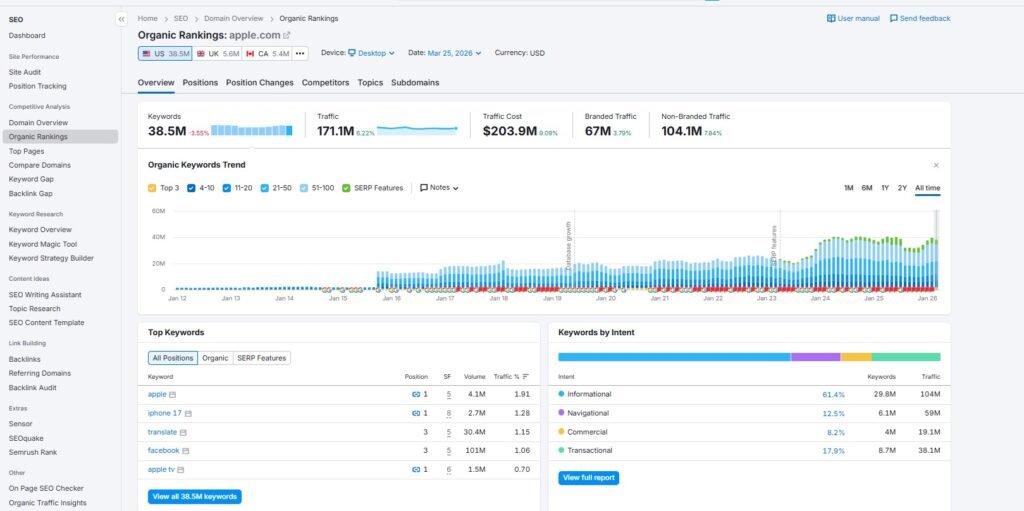
But your goal is not to replicate them. It’s to go one level deeper — to make your content more usable.
Don’t try to outperform competitors by doing more. Focus on doing it better — especially in areas where they are vague or generic. That’s where real opportunities exist.
Step 4: Understand the Digital Marketing Ecosystem
At this point, it’s important to zoom out.
A digital marketing strategy is not just SEO. It’s a combination of channels, each playing a different role.
Think of it like this.
SEO helps you capture demand that already exists. People are searching, and you appear.
Paid ads, like Google Ads or Meta Ads, help you create immediate visibility. You can target specific audiences and drive traffic quickly.
Social media platforms such as Instagram, LinkedIn, or YouTube help you build awareness and engagement. They’re not always direct conversion channels, but they shape perception.
Email marketing helps you stay connected with people who have already shown interest. It’s one of the most effective ways to nurture leads.
Content sits underneath all of this. It’s the foundation that supports SEO, social, and even ads.
Understanding this ecosystem helps you avoid a common mistake — relying entirely on one channel.
If you need quick results, you might lean more into paid ads. If you’re building long-term growth, SEO and content become more important.
The key is not to use everything at once, but to understand what each channel does and when to use it.
At this stage, you don’t need to use every channel. The smarter approach is to pick one or two channels and execute them properly. Trying to do everything at once usually leads to inconsistent results.
Also read: Digital Marketing for Small Businesses: 5 Strategies That Actually Work
Step 5: Map Your Customer Journey (Where Strategy Becomes Clear)
Now that you understand channels, the next step is connecting them to how people actually make decisions.
Most customers don’t go from discovering you to buying instantly. They move through stages.
At the beginning, they’re just becoming aware of a problem. They might search something like “why is my website not getting traffic.” This is where blog content or educational videos work well.
Then they move into a consideration phase. They start comparing solutions, looking at guides, reading case studies.
Finally, they reach a decision stage. Now they’re searching for services, pricing, or contacting businesses directly.
Your strategy should align with this journey.
For example:
- SEO content helps you capture awareness-stage searches
- Retargeting ads (through Meta Ads Manager or Google Ads) can bring back visitors who didn’t convert
- A well-structured service page helps convert decision-stage users
This is where channels start working together instead of in isolation.
Step 6: Choose the Right Channels (Focus Instead of Doing Everything)
At this stage, many businesses feel tempted to use every platform available.
That usually leads to scattered effort.
Instead, make decisions based on your audience and goal.
If your audience actively searches for solutions, SEO should be a priority. If you need faster results, Google Ads can help you appear immediately for high-intent queries.
If your audience spends time on platforms like Instagram or LinkedIn, use those channels to build visibility and trust.
A practical way to start is to choose:
- One primary traffic channel (SEO or ads)
- One supporting channel (content or social)
- One conversion path (your website or landing page)
This keeps your strategy focused and manageable.
Step 7: Build Your Keyword and Content Strategy (Execution Layer)
Now we move into actual execution.
Start by going to Semrush’s Keyword Magic Tool. Enter your core topic and filter results based on keyword difficulty and intent.
Look for terms that directly relate to your services and audience needs.
Once you have a list, group them into categories:
- Informational queries (guides, how-to content)
- Comparison queries (best, vs, alternatives)
- Transactional queries (services, pricing)
This grouping helps you build a content structure that aligns with the customer journey.
For example, an article like this one targets informational intent, while a page about “digital marketing services UK” targets decision intent.
Each piece of content should have a clear role in moving users closer to action.
Step 8: Plan Your Campaigns (How Channels Work Together)
This is where many strategies stop — and where real execution begins.
A strategy is not just content or ads. It’s how they connect.
Imagine this flow.
Someone finds your blog through Google. They read it but don’t take action.
You run a retargeting campaign using Meta Ads Manager, targeting people who visited your website in the last 30 days. They see an ad offering a free consultation.
They click the ad, land on a focused landing page, and submit their details.
You follow up through email with additional information or an offer.
This is a simple campaign, but it shows how channels work together:
SEO → Ads → Landing Page → Email
To set this up, you would:
- Install the Meta Pixel on your website
- Create a custom audience based on website visitors
- Build a campaign in Meta Ads Manager with a “Leads” or “Conversions” objective
- Monitor metrics like cost per lead and click-through rate to optimise performance
This is where strategy becomes real.
Step 9: Structure Your Website for Conversion
Traffic alone doesn’t grow your business. What matters is what happens after someone lands on your site.
Your website should guide users.
A blog post should lead to related content or a service page. A service page should clearly explain what you offer and include a strong call to action.
If you’re unsure, open your own site and navigate it as a user. Ask:
- Is it clear what this business does?
- Is the next step obvious?
If not, adjust your structure.
Internal linking also plays a role here. Linking relevant pages helps both users and search engines understand your site better.
Step 10: Plan Budget and Resources (Make It Realistic)
A strategy that ignores budget is not a strategy.
If you have limited resources, focus on organic channels like SEO and content. They take time but require less upfront cost.
If you have budget, you can accelerate results using paid ads.
For example, you might allocate:
- A portion of budget to Google Ads for immediate leads
- Time and effort into SEO for long-term growth
The key is balance.
Step 11: Set Up Tracking (So You Can Actually Improve)
Before running campaigns, set up tracking.
In Google Analytics (GA4), create an account and connect your website. Define key events like form submissions.
In Google Search Console, add your domain and submit your sitemap. This helps you track keyword performance and indexing.
For ads, platforms like Google Ads and Meta Ads Manager provide built-in analytics. Monitor metrics like:
- Click-through rate
- Cost per click
- Conversion rate
But don’t just look at numbers. Interpret them.
If you’re getting traffic but no leads, the issue is likely your landing page or offer. If ads are expensive but converting, you may need to refine targeting.
Step 12: Execute Consistently (Not Perfectly)
Execution doesn’t need to be complex.
What matters is consistency.
Instead of trying to do everything, follow a simple cycle:
- Publish useful content
- Improve existing pages
- Test campaigns
- Analyse results
This steady approach builds momentum over time.
Step 13: Measure and Improve (The Growth Loop)
No strategy is perfect from the start.
The difference between success and failure is how you improve.
Look at your data regularly.
Which pages bring traffic? Which bring leads? Where do users drop off?
Then adjust.
This might mean improving content, refining targeting, or testing different offers.
Over time, these small improvements compound.
Final Thought
At this point, you don’t need more information.
You need to take the first step.
Start simple:
- Define your goal
- Identify your audience
- Choose one channel
- Execute consistently
If you try to do everything at once, you’ll get stuck. If you start small and stay consistent, you’ll build momentum.
And if you reach a stage where managing keywords, content, campaigns, and tracking starts to feel overwhelming, that’s usually not a lack of effort — it’s a lack of structure.
That’s where working with a digital marketing agency in london like Rankraze makes a real difference.
Instead of trying to figure everything out on your own — from keyword planning to content execution and performance tracking — you get a structured approach built around your business goals. The focus shifts from “doing everything” to “doing the right things consistently.”
If you’re serious about building a strategy that actually drives results, start applying what you’ve learned here — and refine it as you go.
And when you’re ready to scale it properly, get the right support behind it.