
SEO hasn’t become simpler. It has become more layered.
You’re no longer just competing for rankings. You’re competing for clicks, visibility, and now even attention inside AI-generated results.
That’s exactly why statistics matter. Not random numbers — but the kind that actually show what’s working, what’s changing, and where things are heading.
This page breaks down 70+ SEO statistics for 2026, grouped by what actually matters — traffic, rankings, behavior, AI, and backlinks.
Table of Contents
Top SEO Statistics for 2026 (Quick Highlights)
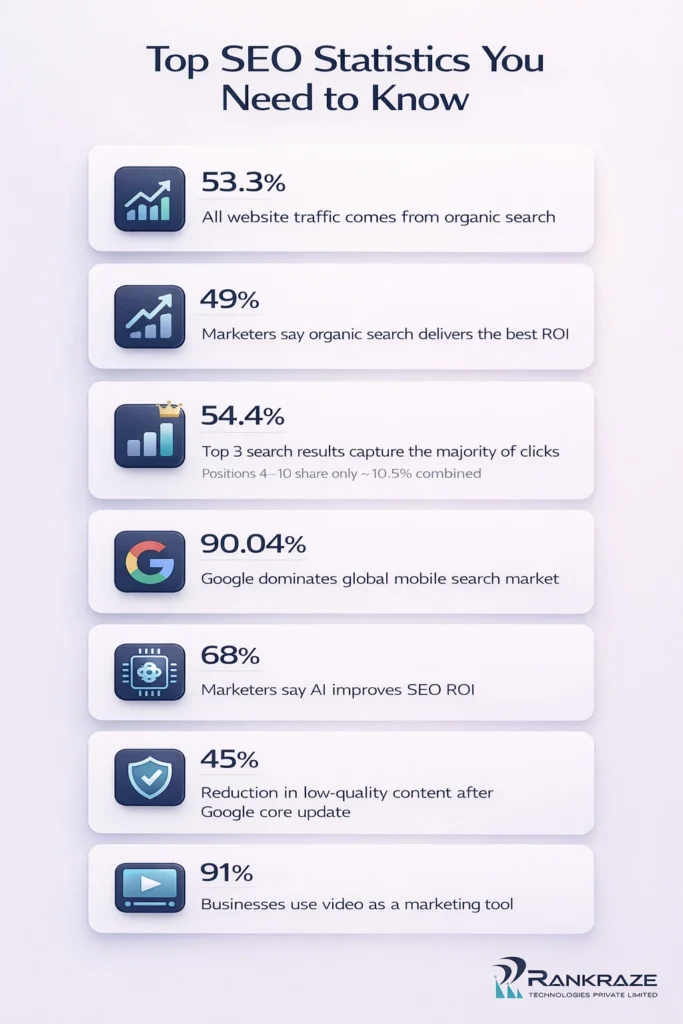
SEO in 2026 is no longer just about rankings — it’s about visibility, behavior, and how users interact with search. From organic traffic dominance to AI-driven results and mobile-first indexing, the landscape has evolved significantly. These quick highlights give you a snapshot of the most important trends shaping modern SEO.
- 53.3% of all website traffic comes from organic search
- 68% of online experiences begin with a search engine
- Google holds 90% of global search market share
- Top 3 results capture 54.4% of all clicks
- Only 0.63% of users click page 2 results
- SEO leads have a 14.6% close rate vs 1.7% outbound
- 60% of searches now end without a click
- AI Overviews appear in up to 15.89% of queries
- 91% of businesses use video in marketing
- Mobile drives over 62% of search traffic
These statistics clearly show one thing — SEO is still the backbone of digital growth, but the rules are changing fast. If you want to stay competitive, you need to adapt to evolving user behavior, SERP features, and content expectations rather than relying on outdated tactics.
SEO ROI & Effectiveness Statistics
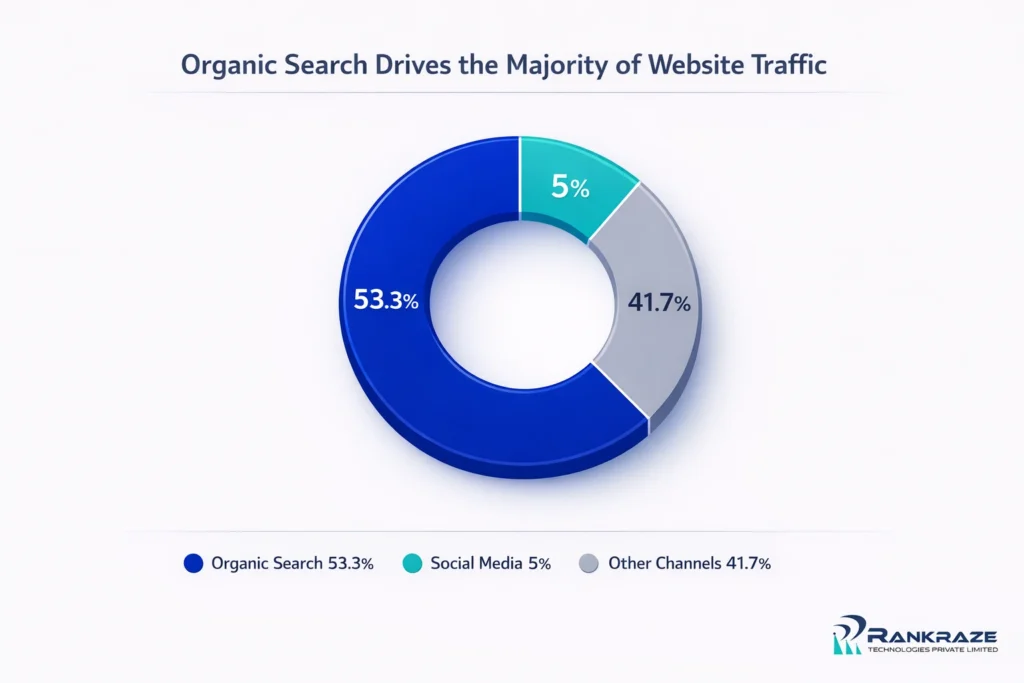
1. 53.3% of all website traffic comes from organic search — still the dominant channel.
Search continues to drive more than half of all website visits globally, making it the most reliable acquisition source. Even with the rise of paid ads and social media, organic search consistently delivers the highest share of traffic.
Source: searchatlas.com
2. SEO drives over 1,000% more traffic than organic social — and the gap isn’t even close.
On average, websites get around 53.3% of their traffic from search, while organic social contributes just 5%. This massive gap highlights how limited social reach is compared to the scalability of SEO.
Source: searchatlas.com
3. SEO leads convert at 14.6%, compared to just 1.7% from outbound.
Users coming from search already have intent, which makes them far more likely to convert into customers. Outbound marketing, on the other hand, interrupts users and typically results in much lower conversion rates.
Source: taylorscherseo.com
4. 61% of marketers say SEO is their top inbound priority right now.
SEO is no longer optional — it has become a core driver of long-term business growth. Most marketing teams are actively investing in improving their organic visibility and rankings.
Source: taylorscherseo.com
5. 69% of marketers actively invest in SEO — and the real number is likely higher.
Across multiple surveys, SEO investment consistently crosses the 70% mark among marketers. This indicates rising competition, as more businesses prioritize organic growth strategies.
Source: ahrefs.com
6. SEO + content marketing generates 3x more leads at 62% lower cost.
Inbound marketing doesn’t just bring in more leads — it does so far more efficiently than traditional methods. This is why many companies are shifting budgets from outbound to SEO-driven content strategies.
Source: demandsage.com
7. SEO is ranked as the #1 ROI channel by marketers.
Compared to paid ads, social media, and email marketing, SEO consistently delivers stronger long-term returns. Its compounding nature makes it more sustainable and cost-effective over time.
Source: hubspot.com
8. 49% of marketers say organic search delivers the best ROI.
Nearly half of marketers consider SEO the highest-performing channel in terms of returns. This signals a clear shift in budget allocation toward organic growth strategies.
Source: demandsage.com
9. SEO leads cost 84% less per conversion than the industry average.
Studies comparing multiple channels show SEO as significantly more cost-efficient. Lower acquisition costs combined with higher intent make it one of the most profitable channels.
Source: upgrowth.in
10. Content marketing costs 62% less than outbound while generating 3x more leads.
Content-driven SEO is not just cheaper — it also produces better results in terms of lead generation. This makes it the default growth strategy for businesses focused on long-term scalability.
Source: demandsage.com
Search Behaviour Statistics
11. 68% of all online experiences start with a search engine.
Before users visit a site, they usually begin with a search query. This makes search engines the primary gateway to most digital journeys.
Source: wonderful.io
12. There are 5.5 billion internet users — and most rely on search daily.
Search is tPeople turn to search engines to find answers, products, and services every day. As internet usage continues to grow, reliance on search becomes even stronger.
Source: hubspot.com
13. Up to 90% of users perform a search every day.
Search is no longer an occasional activity — it has become a daily habit for most users. People depend on it consistently to solve problems, learn, and make decisions.
Source: searchatlas.com
14. Google processes 8.5+ billion searches per day.
That translates to nearly 99,000 searches every second. The sheer volume shows how massive and constantly active search demand really is.
Source: seo.ai
15. 15% of Google searches are completely new queries.
Users are constantly searching for things that have never been searched before. This creates endless opportunities for new content to rank and capture traffic.
Source: alloutseo.com
16. Over 684 million searches happen every hour on Google alone.
Search demand never pauses — it runs continuously throughout the day. If your business isn’t visible, you’re missing out on a constant stream of potential traffic.
Source: electroiq.com
17. 62.54% of organic traffic now comes from mobile devices.
Search demand never pauses — it runs continuously throughout the day. If your business isn’t visible, you’re missing out on a constant stream of potential traffic.
Source: searchatlas.com
18. 76% of “near me” searches lead to a visit within a day.
Local search intent is incredibly strong, especially when users are looking for nearby solutions. These searches often result in quick, real-world actions.
Source: ahrefs.com
19. 28% of local searches result in a purchase.
Local SEO isn’t just about visibility — it directly drives revenue. High intent from nearby users often leads to immediate conversions.
Source: ahrefs.com
20. 93% of purchases start with an online search.
Search plays a critical role in nearly every buying decision today. If your business isn’t visible in search results, you may not even be considered by potential customers.
Source: blog.6minded.com
Google Market Share Statistics
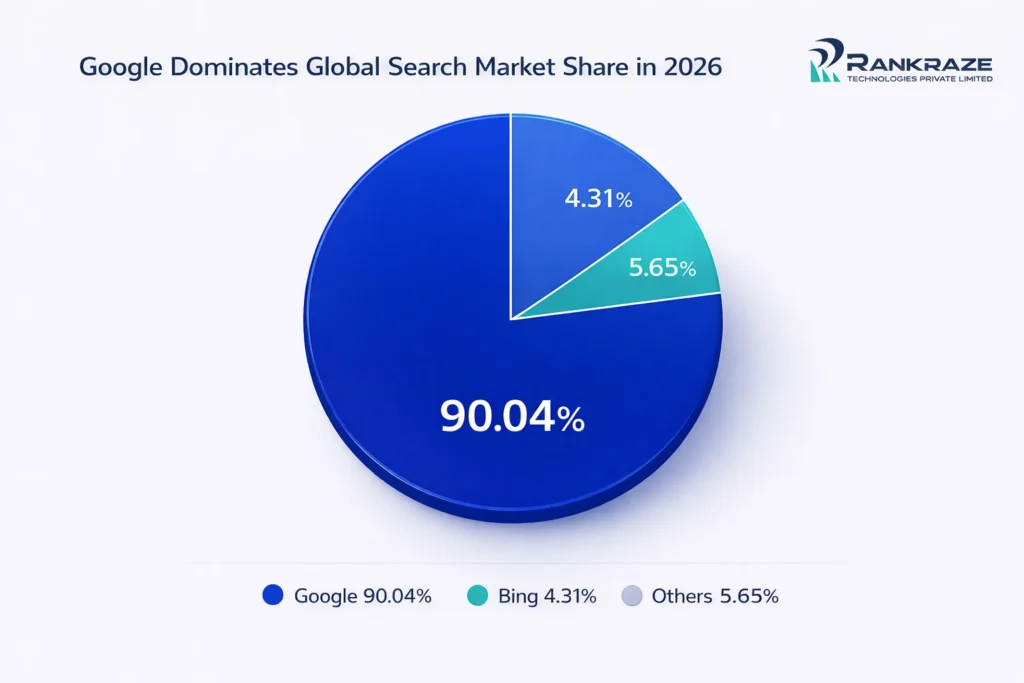
21. Google owns 90.04% of the global search market — it’s basically the internet’s gateway.
For most users, search effectively means Google. This level of dominance means SEO strategies are largely built around Google’s ecosystem and algorithms.
Source: resourcera.com
22. Bing holds just 4.31% of global search share — a distant second.
Even though Bing is steadily growing, it still represents a very small portion of total search traffic. As a result, most SEO impact and traffic potential still come from Google.
Source: resourcera.com
23. Google dominates mobile search even more — with 93.89% market share.
Mobile users rely heavily on Google for their search needs. This makes mobile SEO even more tightly connected to Google’s ranking systems and performance factors.
Source: statista.com
24. YouTube is the world’s second-largest search engine with 3+ billion searches per month.
Search behavior isn’t limited to traditional search engines like Google. Video search is rapidly growing, and YouTube plays a major role in how users discover content.
Source: searchatlas.com
25. Google handles over 5.9 trillion searches every year.
Search volume continues to increase year after year. While this creates more opportunities for visibility, it also intensifies competition across industries.
Source: statista.com
26. Google Chrome controls 67.5% of the global browser market.
Google’s influence extends beyond search into how users access the web. This dominance strengthens its data ecosystem and overall advantage in understanding user behavior.
Source: seo.ai
27. Google Maps and Lens drive billions of discovery searches monthly.
Search is no longer limited to text-based queries alone. Visual and local discovery tools like Maps and Lens are becoming major entry points into user journeys.
Source: demandsage.com
CTR & Ranking Statistics
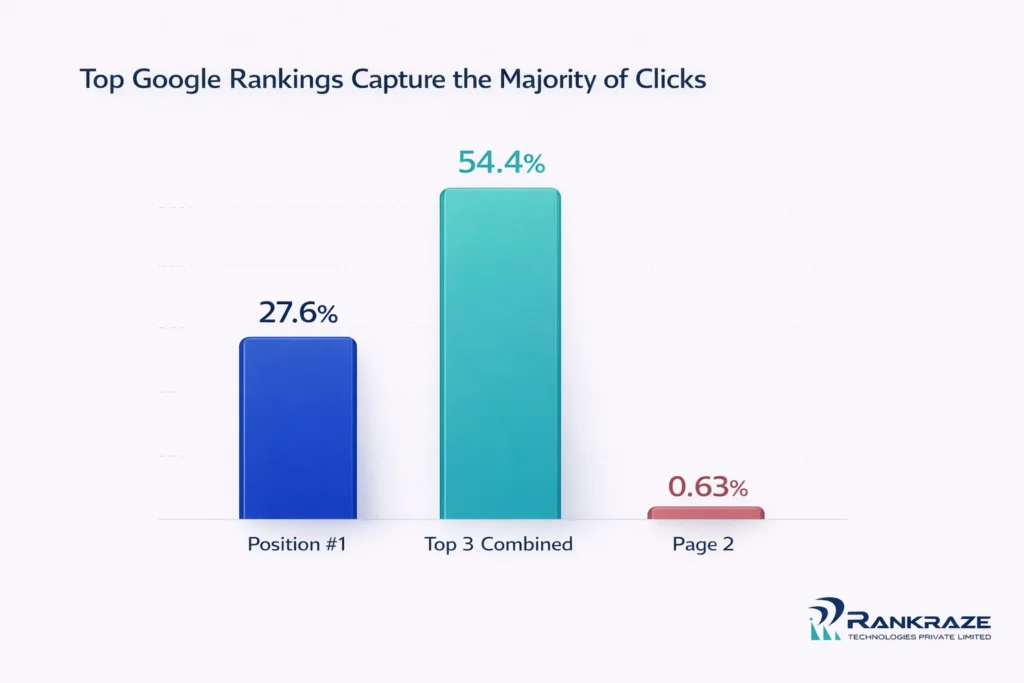
28. The #1 result on Google gets 27.6% of all clicks — more than a quarter of total traffic.
Ranking first isn’t just slightly better — it’s a massive advantage. A large portion of clicks are concentrated at the very top of the search results.
Source: searchatlas.com
29. Top 3 results capture 54.4% of all clicks.
More than half of all users click on one of the first three results they see. If your page ranks below that, traffic potential drops significantly.
Source: searchatlas.com
30. The #1 result gets 10x more clicks than position #10.
There’s a huge gap in visibility even within the first page. While position #10 is technically on page one, it receives only a fraction of the clicks compared to the top result.
Source: ahrefs.com
31. Only 0.63% of users click results on page 2.
Very few users go beyond the first page of search results. Once your page drops to page two, visibility and traffic decline sharply.
Source: searchatlas.com
32. CTR drops sharply after position #3 — the rest share just ~10.5%.
Positions 4–10 receive only a small portion of total clicks. Even a slight improvement in ranking can lead to a noticeable increase in traffic.
Source: seosandwitch.com
33. Featured snippets can capture up to 67% of clicks.
Owning the featured snippet position can outperform even the #1 organic result. This placement significantly changes how users interact with search results.
Source: almcorp.com
34. Search results with sitelinks see CTRs as high as 46.9%.
Rich results with additional links stand out more in the SERP. This improved presentation often leads to higher click-through rates.
Source: highervisibility.com
35. Organic CTR varies by industry and intent
Click-through rates are not fixed and depend heavily on the type of query and user intent. Informational searches behave differently from branded or transactional ones.
Source: backlinko.com
36. Long-tail keywords drive 1.76x more clicks than short queries.
Specific search queries often face less competition and match user intent more closely. This creates opportunities to capture highly targeted traffic.
Source: alloutseo.com
37. Branded searches can reach CTRs of 45% or higher.
When users search for a specific brand, they already have trust and intent. This leads to significantly higher click-through rates compared to generic searches.
Source: backlinko.com
First Page Behaviour Statistics
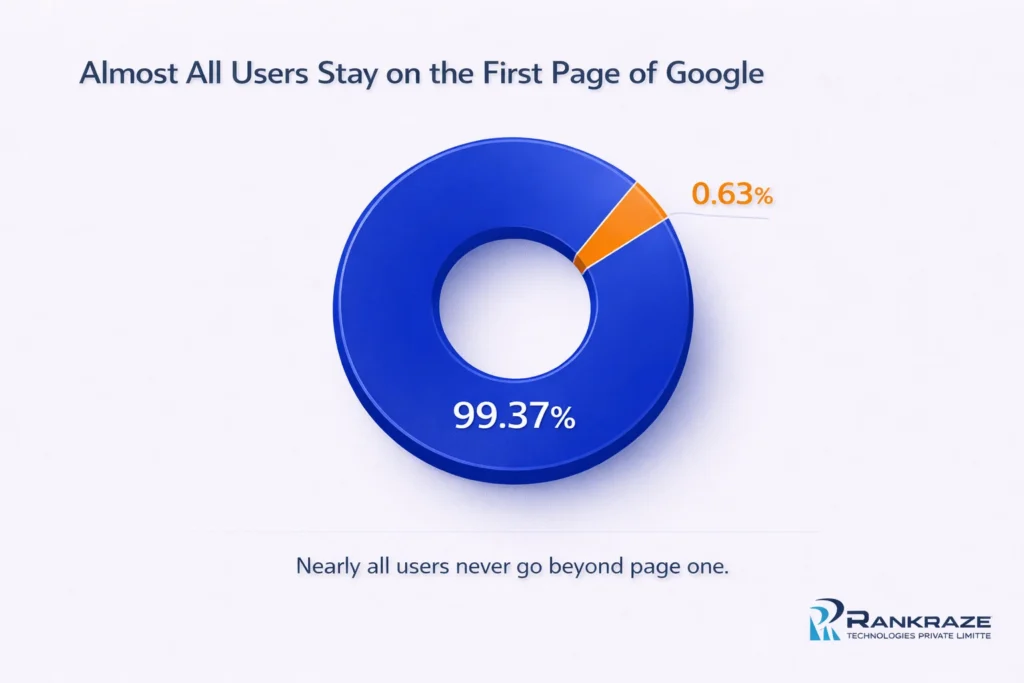
38. 99% of people never goes beyond first page.
More than 99% of users never go beyond the first page of Google search results, making it the most critical real estate for visibility. If your website isn’t ranking on page one, it’s essentially invisible to the vast majority of potential visitors, traffic, and opportunities.
Source: redlocalagency.com
39. 71% of all clicks happen on page one
Search visibility is heavily concentrated on the first page. If you’re not ranking there, you’re missing out on the majority of user clicks and engagement.
Source: redlocalagency.com
40. The top 5 results alone get 67.6% of clicks.
Most users don’t explore the full search results page. They tend to click one of the top listings quickly and move on.
Source: www.responsify.com
41. 65% of users click at least one organic result — ignoring ads.
Organic results still hold strong trust among users. Many people actively skip paid ads and prefer clicking on natural search listings.
Source: revenuememo.com
42. Average bounce rate is 37% — and higher for poorly ranked pages.
Lower rankings often correlate with weaker engagement. If your content doesn’t match user intent, visitors leave quickly without interacting further.
Source: demandsage.com
43. 50% of users click within 9 seconds of searching.
Search decisions happen extremely fast. If your result doesn’t stand out immediately, it gets ignored in favor of competitors.
Source: semrush.com
44. 59% of users visit only one page during their search journey.
Search decisions happen extremely fast. If your result doesn’t stand out immediately, it gets ignored in favor of competitors.
Source: sixthcitymarketing.com
45. 60% of searches now end without a click.
Users often get answers directly on Google through featured snippets or SERP features. This shift is changing how SEO traffic behaves and how content should be optimized.
Source: thedigitalbloom.com
46. Page 2 results get less than 1% of clicks
Very few users continue to the second page of search results. Once your page drops beyond page one, traffic potential becomes extremely limited.
Source: searchatlas.com
Content and Algorithm Statistics
47. Content quality is the #1 ranking factor in Google’s algorithm.
Relevance matters more than anything else in search rankings. If your content doesn’t match user intent, it won’t perform well regardless of optimization.
Source: marketingcharts.com
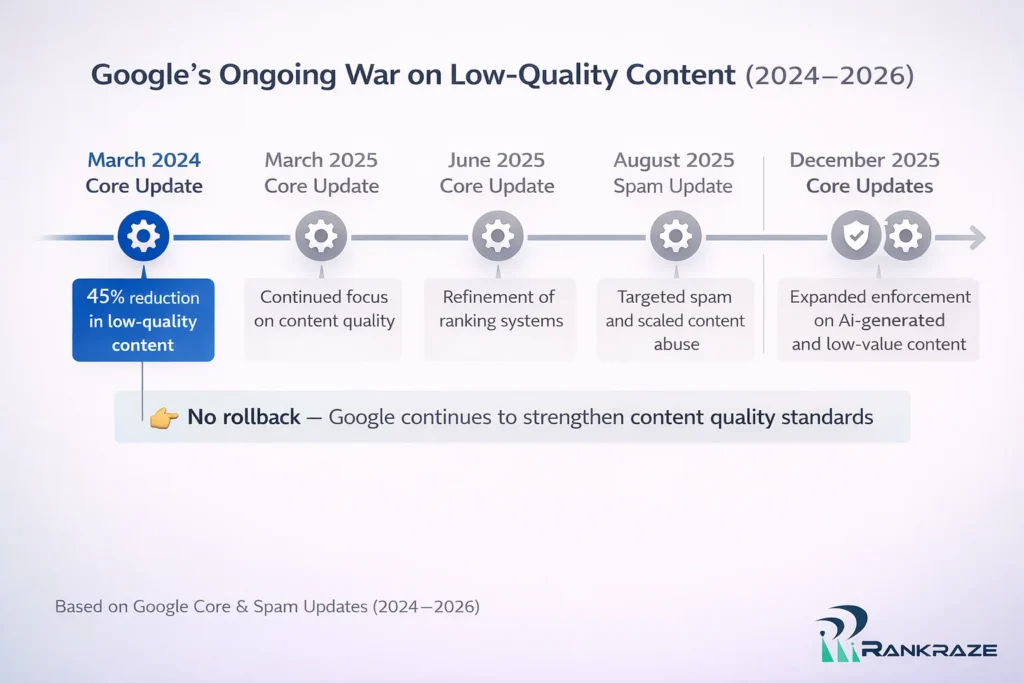
48. Google reduced low-quality content by 45% through algorithm updates.
Google’s March 2024 Core Update achieved a 45% reduction in low-quality and unoriginal content in search results — exceeding its initial 40% target. Since then, Google has released six additional major updates through 2025–2026 (three core updates, one spam update, one Discover update, and the March 2026 spam and core updates), all consistently targeting thin AI-generated content, scaled content abuse, and manipulative SEO tactics, with no reversal of the quality framework established in March 2024.
Source: saffronedge.com
49. Top-ranking pages average 1,447+ words — longer content wins.
Depth plays a major role in ranking performance. Comprehensive content tends to cover topics better and satisfy user intent more effectively.
Source: backlinko.com
50. Pages with strong E-E-A-T perform better
Semrush’s 2024 Ranking Factors study highlights domain and page authority — key components of E-E-A-T — as among the top six ranking signals; sites demonstrating experience, expertise, authority, and trustworthiness recover faster from algorithm updates.
Source: semrush.com
51. Google makes thousands of algorithm updates every year (4,781 in 2023).
Search is constantly evolving, with frequent changes to improve result quality. What works today may not work tomorrow, making adaptability essential in SEO.
Source: alloutseo.com
52. Content relevance is more important than keyword density
Semrush’s 2024 Ranking Factors study found a correlation of −0.47 between content relevance (measured via BERT embeddings) and ranking position, making relevance a far stronger signal than simple keyword density.
Source: marketingcharts.com
53. 85% of AI Overview citations come from recent content.
Fresh content is gaining more visibility, especially in AI-driven search features. Regular updates and timely publishing are becoming critical for maintaining rankings.
Source: position.digital
54. Structured content earns 4.3x more featured snippets.
Clear formatting and logical structure improve both readability and discoverability. Well-organized content increases the chances of appearing in rich results like featured snippets.
Source: surferseo.com
55. 96.55% of pages get zero traffic from Google.
Most content never ranks or attracts visitors. Without a clear SEO strategy, even well-written pages can remain completely invisible.
Source: searchatlas.com
Video SEO Statistics
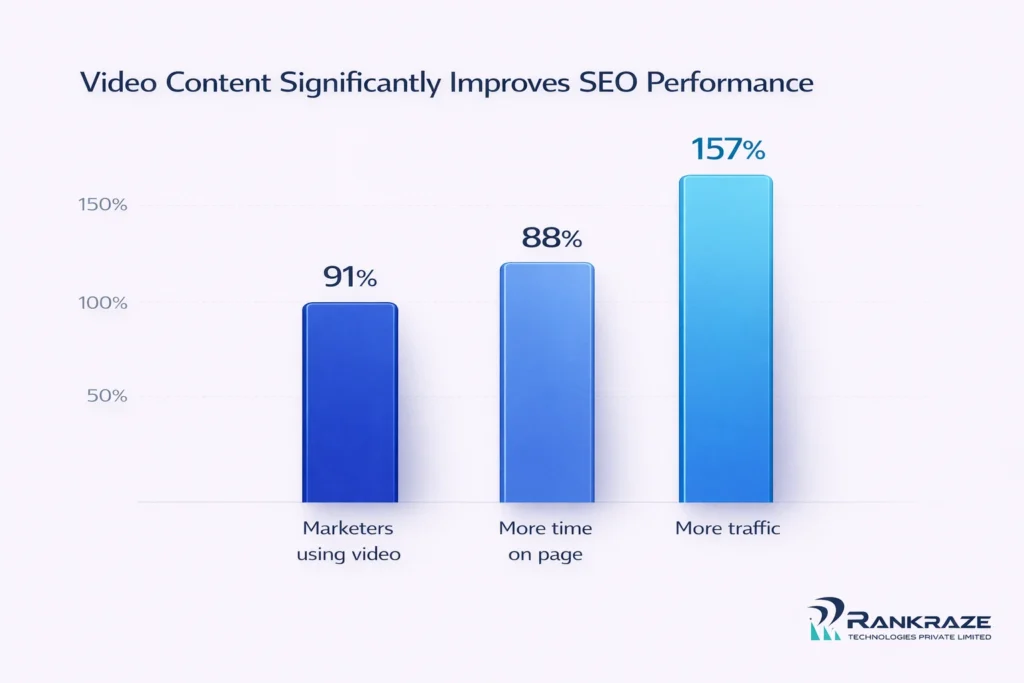
56. 91% of businesses now use video in their marketing strategy.
Video has become a standard part of modern marketing, not just an optional tactic. Most brands are already investing in video to engage audiences and stay competitive.
Source: wyzowl.com
57. Users spend 88% more time on pages with video.
Video content keeps users engaged for longer periods. This increased engagement can positively impact both rankings and conversion rates.
Source: demandsage.com
58. Video content gets 41% higher CTR than text-only pages.
Visual content naturally attracts more attention in search results. It stands out in crowded SERPs and encourages more users to click.
Source: searchatlas.com
59. YouTube is the second largest search engine.
YouTube processes billions of searches every month. This makes it a critical platform for discovery beyond traditional Google search.
Source: searchatlas.com
60. Videos appear in 62% of Google search results.
Google is increasingly prioritizing video content across SERPs. Ignoring video means missing a major visibility opportunity.
Source: searchatlas.com
61. Pages with video are 53x more likely to rank on page one.
Video significantly enhances a page’s ranking potential. It remains one of the most powerful content upgrades for SEO performance.
Source: searchatlas.com
62. Video improves conversion rates.
Most marketers report that video directly impacts sales performance. It helps build trust and clearly communicate value, leading to higher conversions.
Source: wyzowl.com
Mobile SEO Statistics
63. 62.54% of search traffic comes from mobile devices.
Mobile is now the primary way users access search engines. Desktop traffic has become secondary in most industries.
Source: searchatlas.com
64. Google fully switched to mobile-first indexing in 2024.
Google now primarily uses the mobile version of a website for ranking and indexing. This means mobile optimization is no longer optional for SEO success.
Source: developers.google.com
65. A 1-second delay can reduce conversions by up to 7%.
Website speed has a direct impact on user experience and revenue. Even small delays can lead to measurable losses in conversions.
Source: searchatlas.com
66. 53% of mobile users abandon sites that take more than 3 seconds to load.
Slow-loading websites lose users almost immediately. Performance optimization is critical to retaining traffic and improving engagement.
Source: digitalapplied.com
AI & SEO Statistics
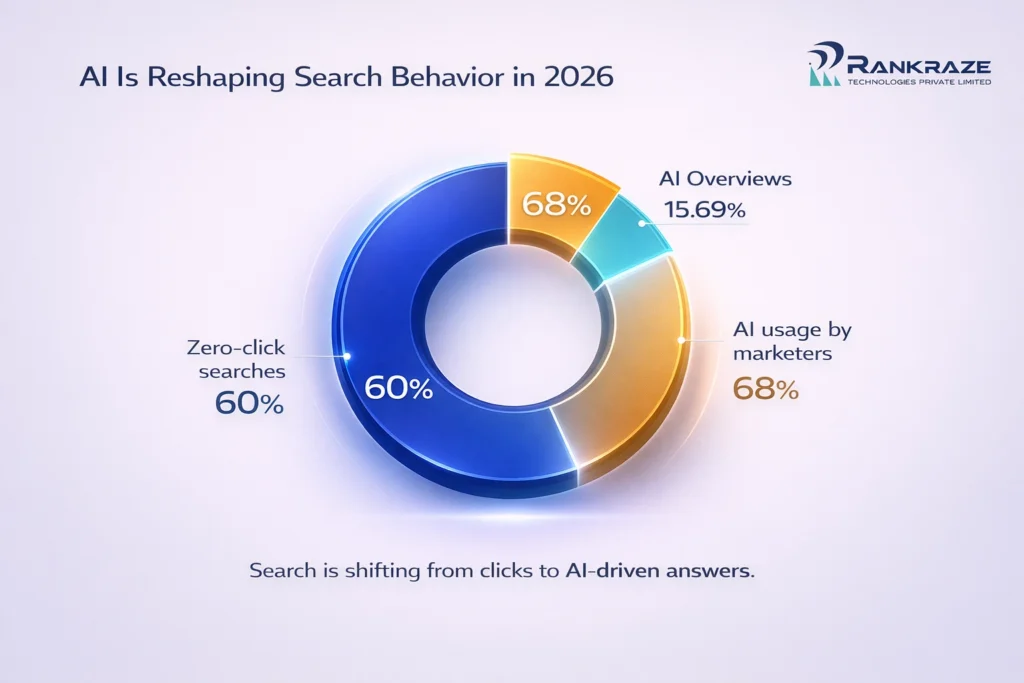
67. AI Overviews now appear in up to 15.69% of search queries.
Search results are evolving with the integration of AI-generated summaries. This shift is starting to reshape visibility and how users interact with search results..
Source: semrush.com
68. 68% of marketers confirm that AI helped them achieve higher ROI
68% of marketers confirm that AI helped them achieve higher ROI from their SEO efforts. At the enterprise level, 83% of SEO professionals at organizations with 200+ employees report measurable SEO performance improvements after adopting AI — with only 6.22% seeing no improvement at all.
Source: seoprofy.com
69. 60% of searches end without a click due to AI answers.
Marketers report measurable improvements in performance after adopting AI tools. AI helps optimize workflows, reduce effort, and increase overall efficiency.
Source: thedigitalbloom.com
70. 85% of marketers now use AI for content and SEO.
AI adoption is rapidly growing across the industry. It is becoming a standard tool for content creation, optimization, and research.
Source: demandsage.com
71. 80% of marketers say AI is helpful for content writing tasks.
Most marketers find AI useful for generating ideas and drafting content. It speeds up the writing process while maintaining productivity.
Source: humanizeai.io
72. 92% of marketers plan to use AI in SEO by 2026.
Over 92% of marketers plan on or are already using SEO optimization for both traditional and AI-powered search engines in 2026, and 68% of organizations are actively changing their SEO strategies to adapt to AI search.
Source: hubspot.com
73. Voice search continues to grow with AI assistants
20% of mobile searches are conducted via voice; the number of voice assistants is projected to reach 8.4 billion by 2026, and 65% of Google Home and Amazon Echo users say they don’t want to return to keyboard searches.
Source: demandsage.com
Backlinks and Authority Statistics
74. Backlinks remain one of Google’s top 3 ranking factors.
Links still play a crucial role in determining website authority. They act as signals of trust and relevance in Google’s ranking algorithm.
Source: backlinko.com
75. #1 ranking pages have 3.8x more backlinks than others.
Pages with more backlinks consistently rank higher; #1 results have 3.8x more backlinks than results in positions #2–#10, and there is a strong positive correlation between referring domains and ranking position.
Source: backlinko.com
76. High-authority domains pass more ranking power
Domain authority score was the 6th most influential ranking factor in Semrush’s 2024 study, with a correlation of 0.21 to rankings. High-authority domains consistently outperform low-authority domains in competitive SERPs.
Source: marketingcharts.com
77. Link relevance matters more than quantity
Referring domain diversity was ranked the 12th most influential factor in Semrush’s 2024 study; Google has increasingly de-emphasized raw link count in favor of relevance, with Google’s Gary Illyes stating in 2023 that “people overestimate the importance of links” and that “we need very few links to rank pages.”
Source: searchengineland.com
78. Content over 3,000 words earns 3.5x more backlinks.
Long-form content tends to attract more links because it provides deeper value. Comprehensive resources are more likely to be referenced and shared.
Source: seomator.com
79. Original research gets the highest backlinks.
Original research and proprietary data studies are the #1 content format for earning backlinks. The Backlinko-BuzzSumo analysis of 912 million blog posts found 94% of all content has zero backlinks — while original data-driven content earns disproportionately high link counts.
Source: backlinko.com
Conclusion
If you look at all these stats together, one thing becomes clear:
SEO is no longer just about rankings.
It’s about:
- Getting visibility
- Holding attention
- And turning that into real results
A lot of websites still chase traffic.
Very few turn that traffic into growth.
If you’re trying to move beyond just numbers and actually build something that converts, working with a team like Digital Marketing Agency in London – Rankraze can help you turn strategy into real outcomes.
Also Read: 30+ Local SEO Statistics for 2026: Data, Trends, Conversion Rates & Google Maps Insights
What percentage of website traffic comes from SEO?
Around 53.3% of all website traffic comes from organic search. This makes SEO the largest traffic source, ahead of paid ads and social media.
Why is ranking on the first page of Google important?
Because over 99% of users never go to page two. If you’re not on the first page, you’re practically invisible in search.
What is the CTR for the #1 position on Google?
The #1 result gets around 27.6% of all clicks. That’s a huge share compared to lower positions.
How has AI changed SEO?
AI has introduced things like AI Overviews and zero-click searches, which reduce clicks but increase competition for visibility inside search results.