Software Development Company for Startups
- ✔ Validate your product idea before investing heavily in development
- ✔ Launch an MVP faster with essential features and a clear technical roadmap
- ✔ Build scalable web, mobile and cloud-based software
- ✔ Work with a dedicated team across design, development, testing and deployment
- ✔ Maintain complete visibility over timelines, budgets and product progress
Trusted by 2,000+ world-class brands and organizations of all sizes
About Our
Startup Software Development Company
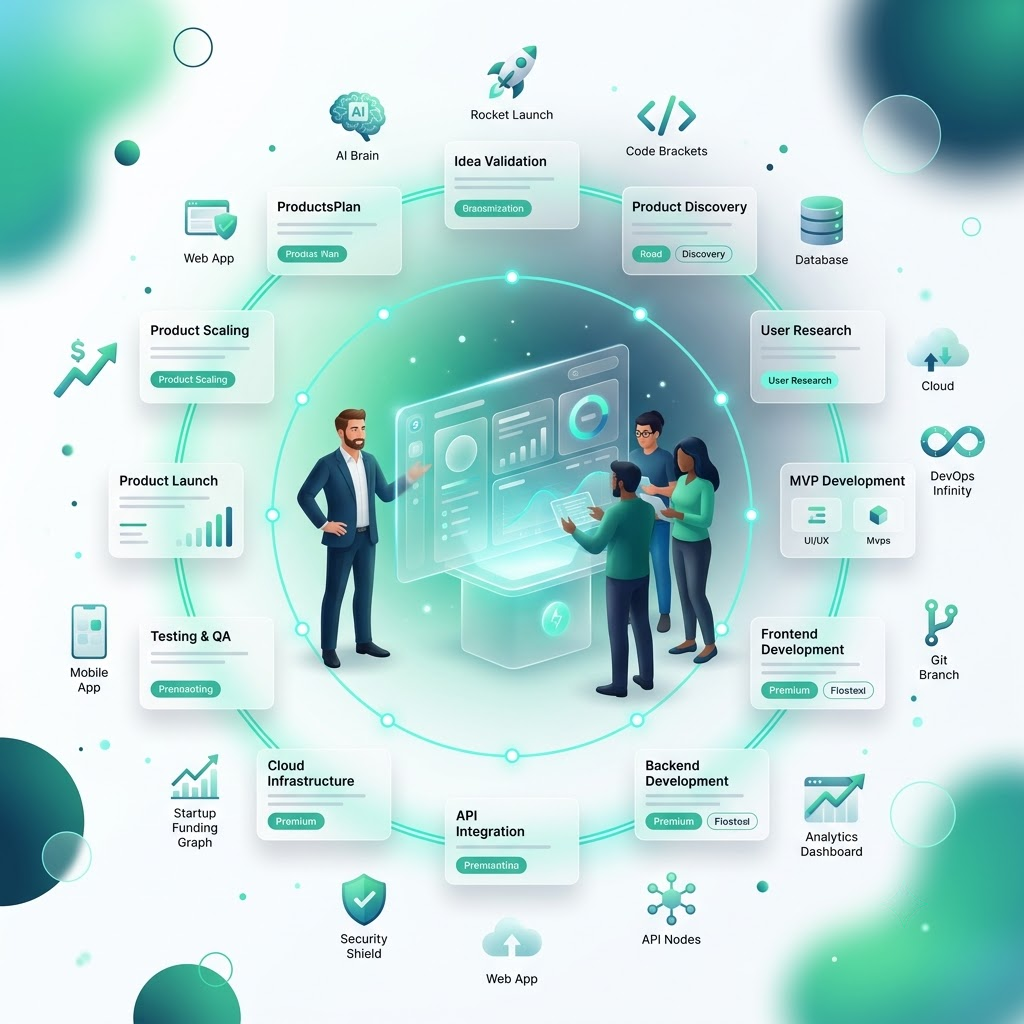
Building software for a startup is different from developing a conventional business website or an internal tool with fixed requirements. Startup products often begin with assumptions that must be tested through customer feedback, product data and real market behaviour.
At Rankraze, we help founders move from an initial idea to a structured, usable and scalable software product. Our work covers product discovery, user experience design, MVP development, web and mobile applications, cloud infrastructure, integrations, testing, deployment and ongoing product improvement.
We do not begin by writing code immediately. First, we work to understand the problem your startup wants to solve, the people who experience that problem and the minimum functionality required to deliver genuine value. This reduces the risk of spending months developing features that customers may not use.
A startup entering the market for the first time needs speed, but speed should not come at the cost of stability. A rushed product with unclear workflows, poor performance or security weaknesses can damage user confidence before the business has an opportunity to grow. Our approach balances fast delivery with a technical foundation that can support future development.
We can work with founders who have only an early product concept, businesses with completed wireframes, startups replacing a prototype or companies improving an existing application. The engagement is shaped around your current stage, internal capabilities, funding position and launch priorities.
Our objective is to give you a product that is practical enough to launch, flexible enough to improve and dependable enough to support your next stage of growth.
Why Startups Need Professional Software Development
Five reasons founders choose a structured, professionally engineered foundation over a rushed build.
Launch an MVP Without Building Unnecessary Features
An MVP, or minimum viable product, is the simplest usable version of your product that delivers its primary value to early customers.
The purpose of an MVP is not to release an incomplete or unreliable application. It is to avoid spending time and money on secondary features before confirming that users want the core solution.
We help founders separate essential launch functionality from features that can be introduced after collecting customer feedback. This makes the first release more manageable and provides a clearer path to market validation.
Ecommerce Digital Marketing Services Built Around the Customer Journey
Our ecommerce services can operate individually, but they deliver greater value when they are connected by one strategy, one reporting structure and shared commercial priorities.
Startup Product Strategy
Startup Product Strategy
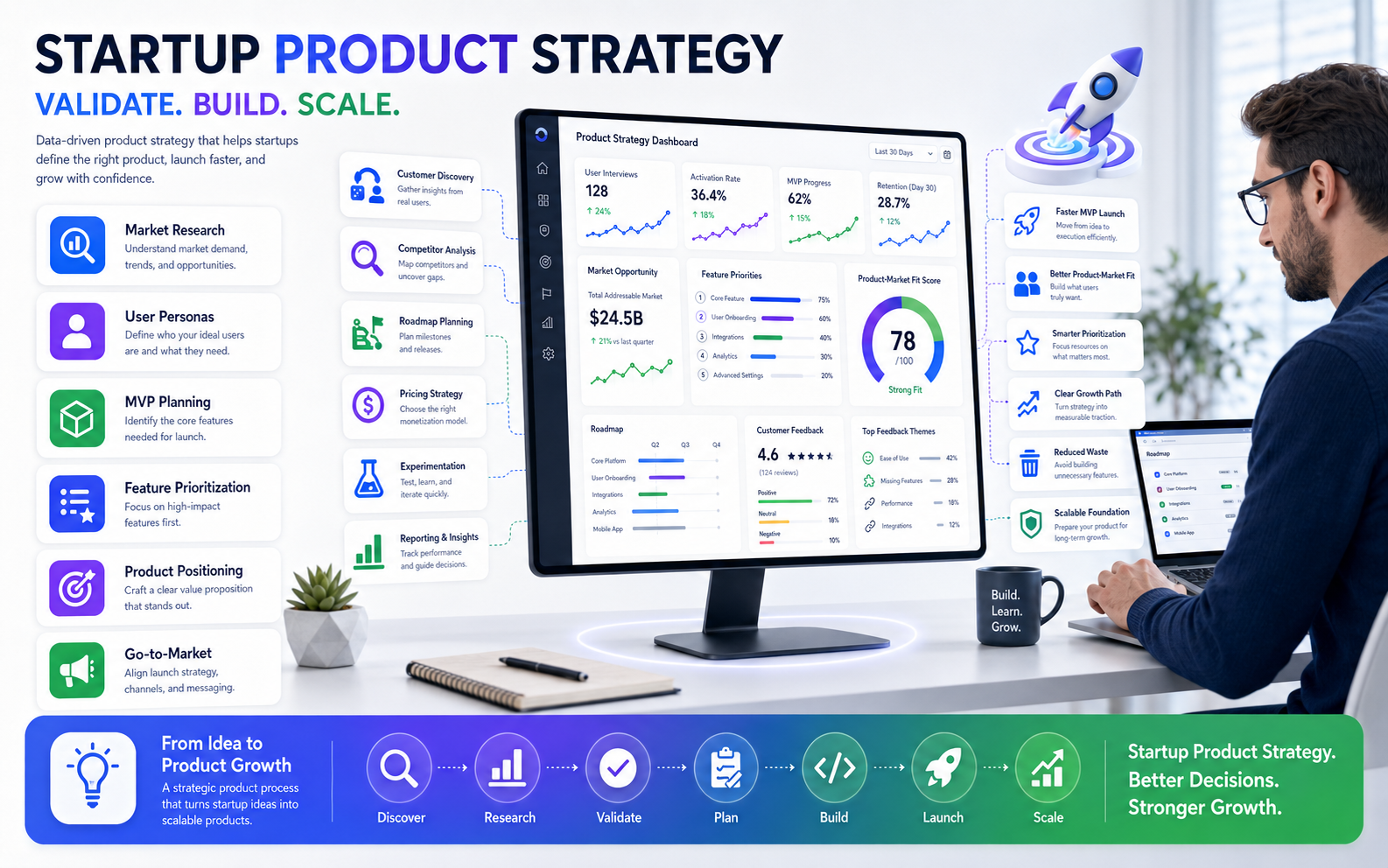
- A successful software product begins with a clear understanding of the market problem, target users and business model.
- We help founders refine the product concept, identify the core value proposition and prioritise the functionality required for the first release. The strategy can also cover product positioning, user roles, monetisation, integrations and future development phases.
- The objective is to create a practical product roadmap rather than a large list of disconnected features.
MVP Development
MVP Development
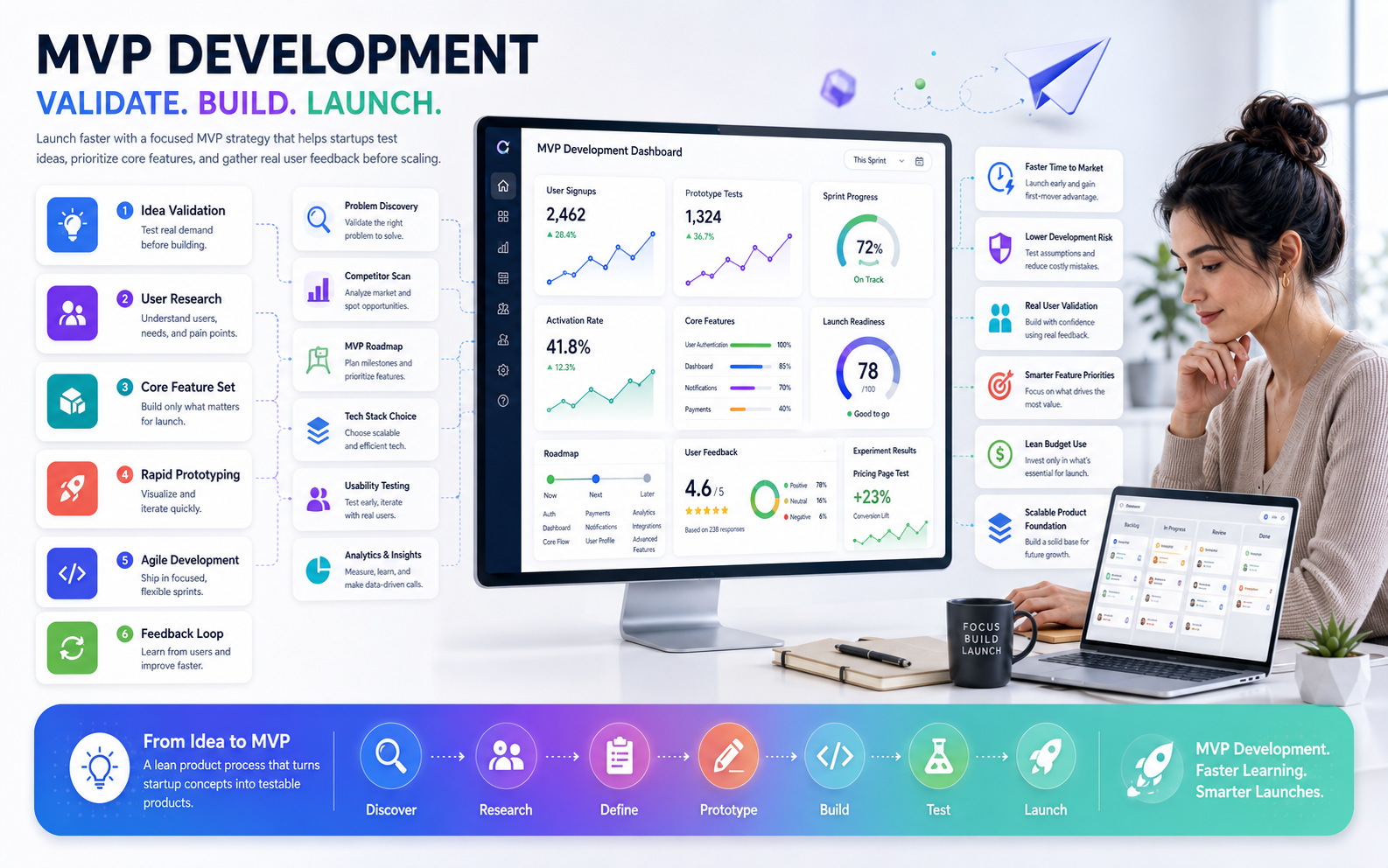
- Our MVP development service helps startups launch a focused version of their product and begin collecting real user feedback.
- We define the core workflows, build the essential features and establish the technical foundation required for future improvements. Development priorities are selected according to user value, commercial importance, implementation effort and technical risk.
- An MVP may include user registration, account management, payments, dashboards, messaging, booking, reporting or another central workflow depending on the product.
Web Application Development
Web Application Development
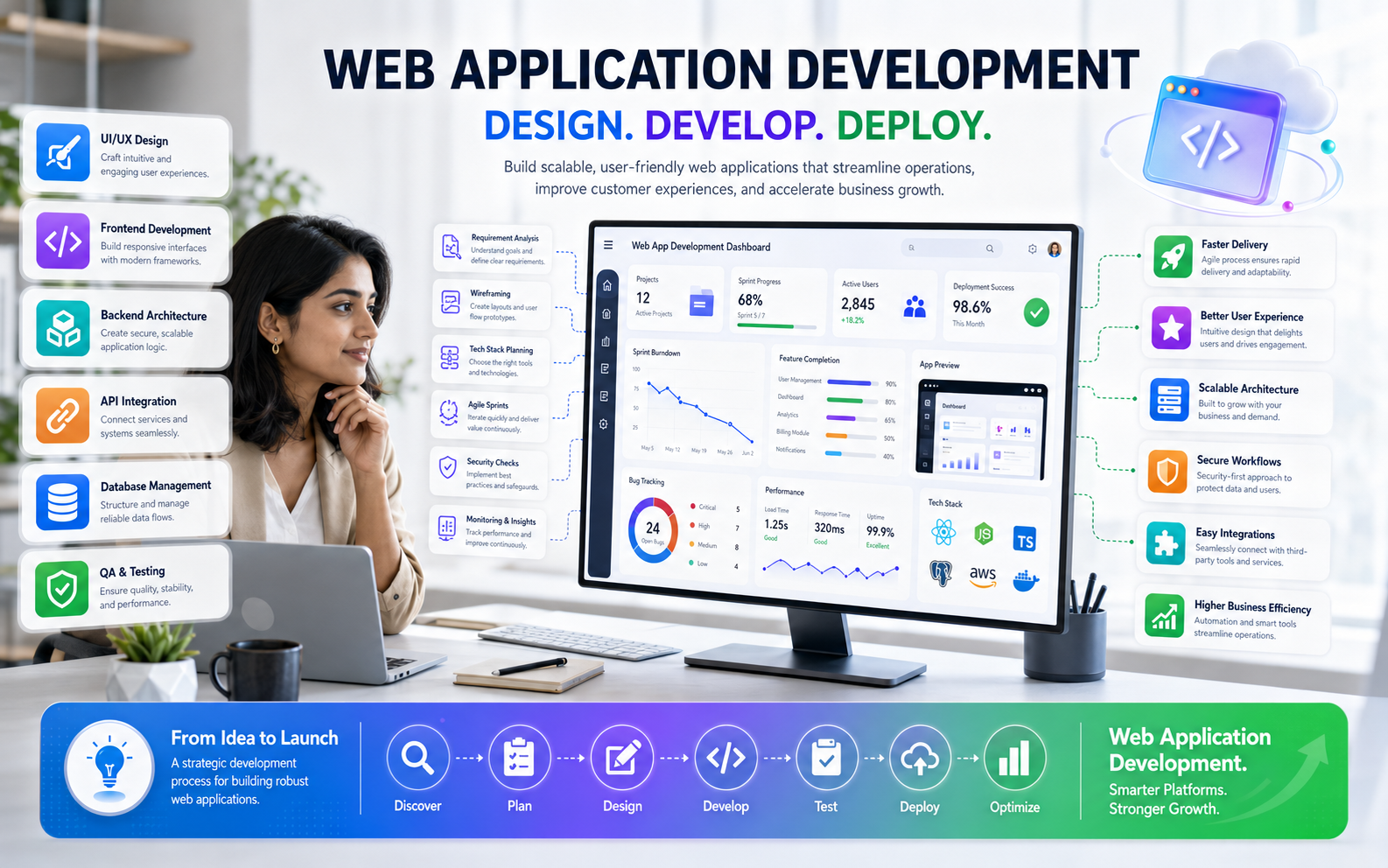
- We build responsive web applications that users can access through desktop, tablet and mobile browsers.
- Web applications can support customer portals, SaaS products, marketplaces, business dashboards, booking platforms, learning systems, healthcare applications and operational tools.
- Our development work can include frontend interfaces, backend systems, databases, APIs, authentication, third-party integrations and administrative controls.
Mobile App Development
Mobile App Development
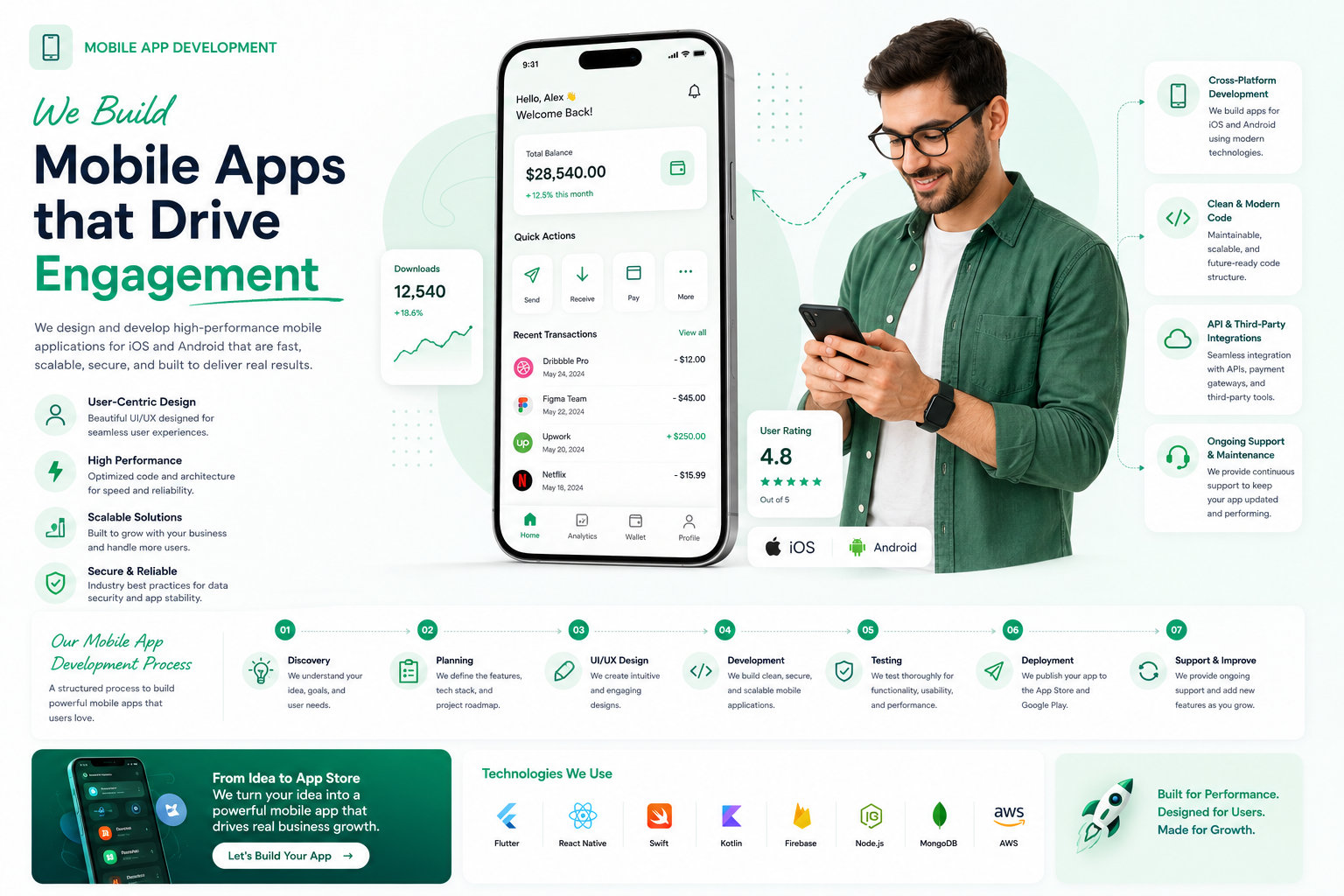
- Software-as-a-Service products require more than a public-facing interface. They often need subscription management, user permissions, account structures, reporting, integrations and secure cloud infrastructure.
- We help startups build SaaS platforms around their pricing model and customer journey. This may include free trials, multiple subscription levels, team accounts, automated billing and administrative dashboards.
- The architecture is planned to support product growth while keeping the early version commercially practical.
UI and UX Design
UI and UX Design
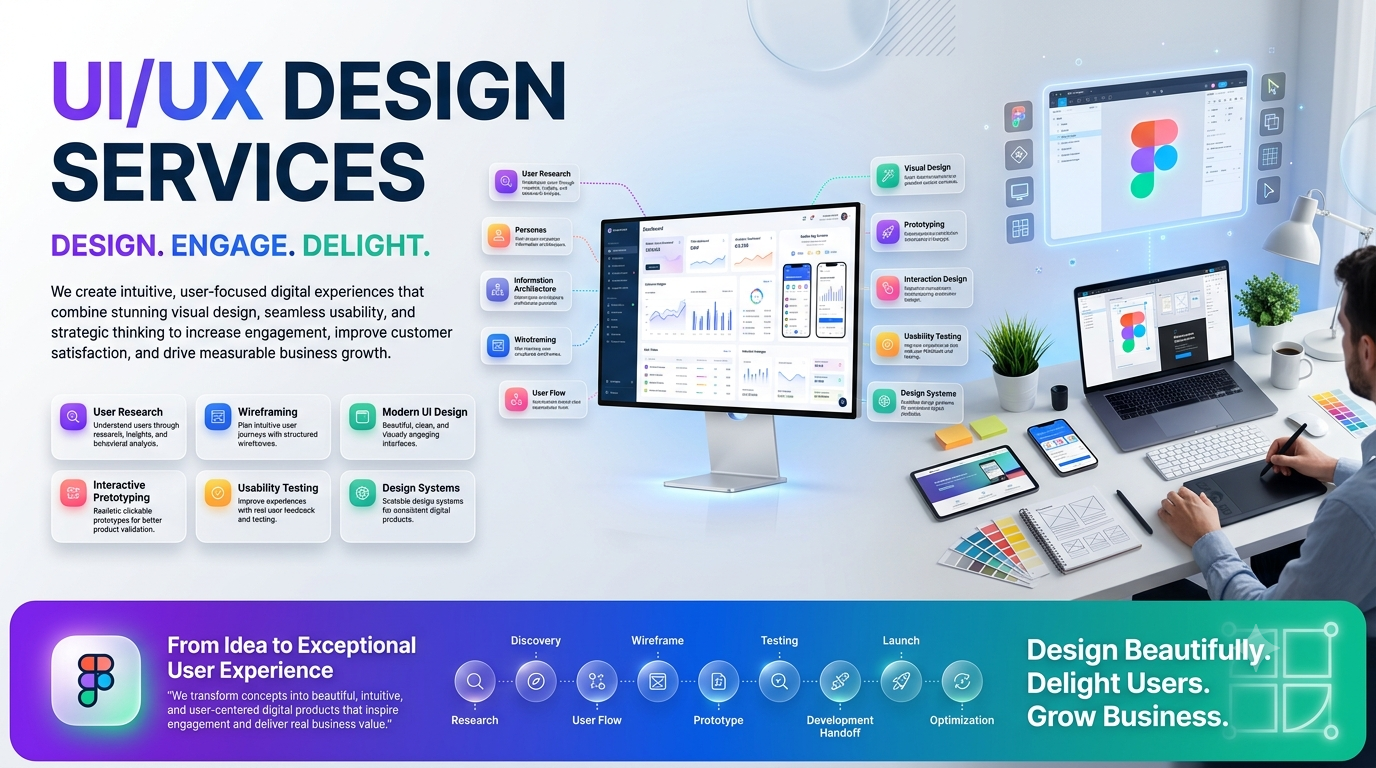
- UI refers to the visual interface of the product, while UX describes the complete experience a person has while using it.
- Our designers create user flows, wireframes, interface layouts and interactive prototypes before full development begins. This allows founders to review the product journey and identify usability issues early.
- The design process focuses on clarity, accessibility, responsiveness and consistency rather than adding visual elements that do not help users complete their tasks.
Backend and API Development
Backend and API Development
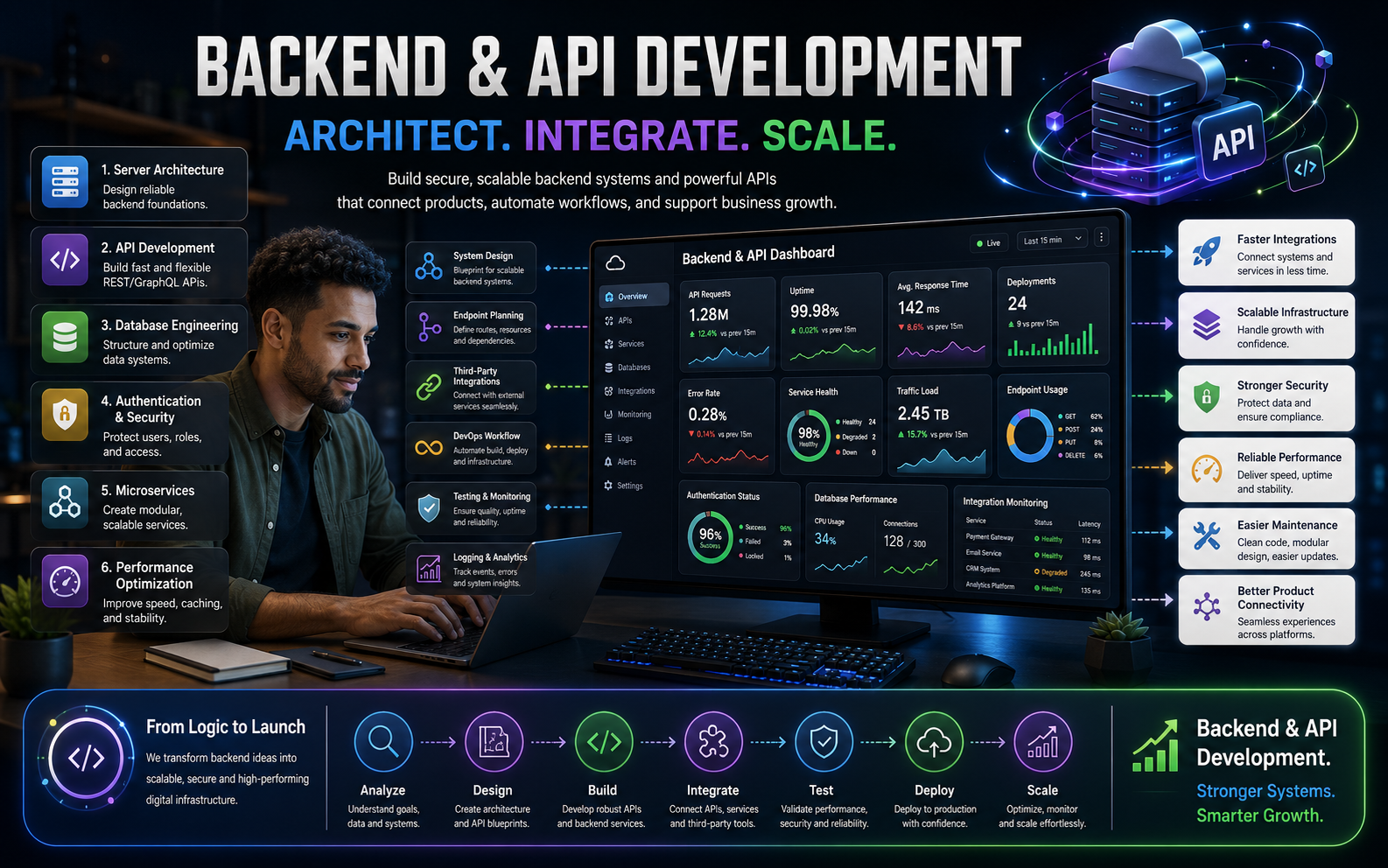
- The backend controls the application’s data, rules, authentication, integrations and core functionality.
- We develop backend systems and APIs that connect user interfaces with databases and external platforms. This may include payment gateways, CRM systems, delivery services, mapping tools, communication platforms and business software.
- APIs are documented and structured to support future mobile applications, partner integrations or additional product modules.
Cloud Application Development
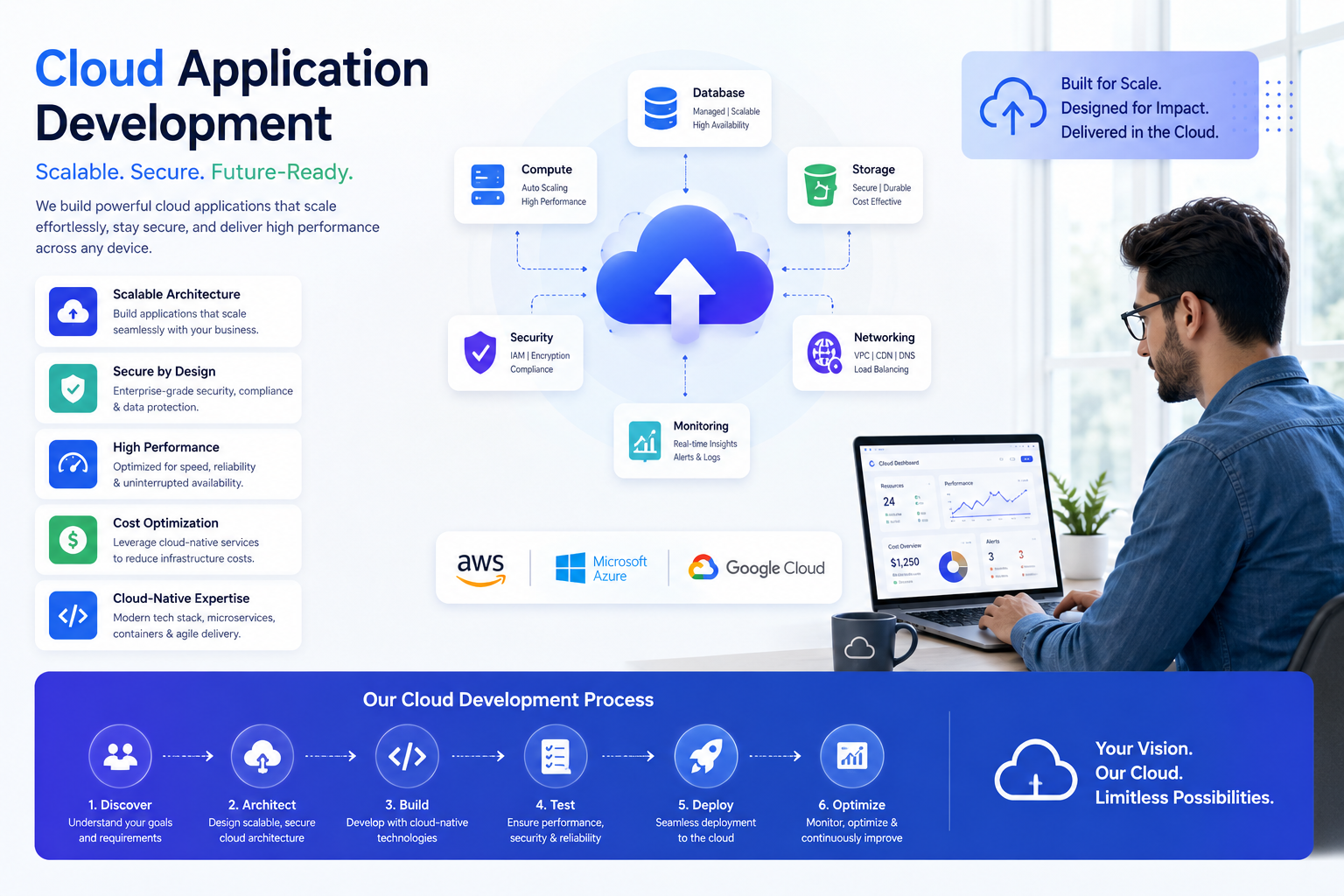
Cloud Application Development
- Cloud infrastructure allows startups to deploy, monitor and scale their applications without maintaining physical servers.
- We can configure development, staging and production environments using suitable cloud services. The setup may include databases, application hosting, file storage, backups, logging and monitoring.
- Infrastructure decisions are matched to the startup’s current usage and expected growth so that early operating costs remain controlled.
Third-Party Software Integrations
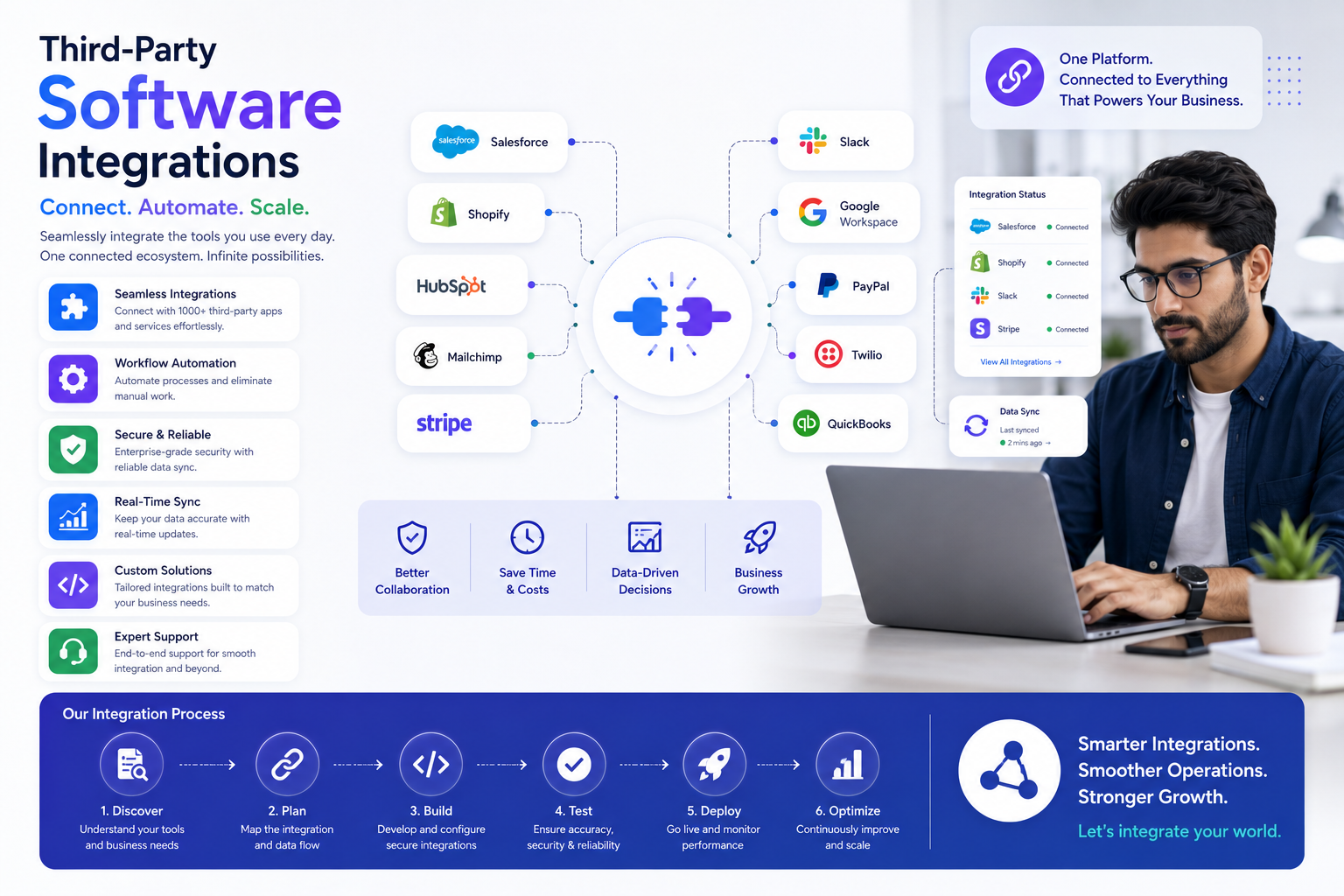
Third-Party Software Integrations
- Many startup products depend on existing services for payments, communication, identity verification, analytics, shipping or customer management.
- We integrate suitable external platforms into your application and test how data moves between systems. Before recommending an integration, we consider pricing, technical documentation, reliability, limitations and future dependency.
- Common integrations may include payment gateways, accounting software, mapping platforms, email providers, SMS services, CRM tools and analytics systems.
Quality Assurance and Software Testing
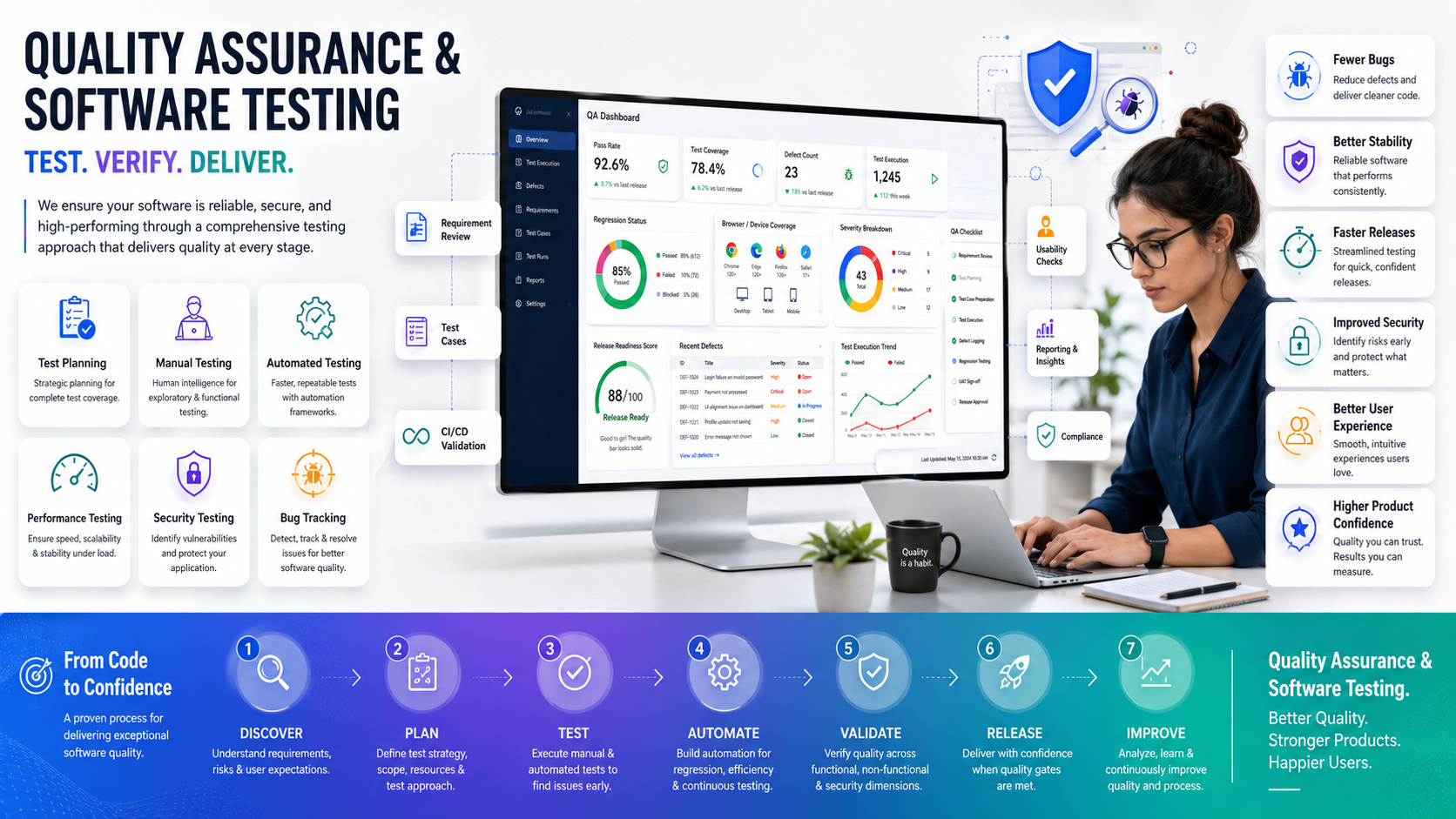
Quality Assurance and Software Testing
- Testing helps identify functional, usability, performance and compatibility problems before customers experience them.
- Our quality assurance process includes reviewing user journeys, individual features, validation rules, responsive layouts, browser behaviour and integrations. Testing priorities are based on how seriously a failure could affect the user or business.
- Critical actions such as payments, account access, data submission and administrative controls receive particular attention.
Legacy Product Modernisation
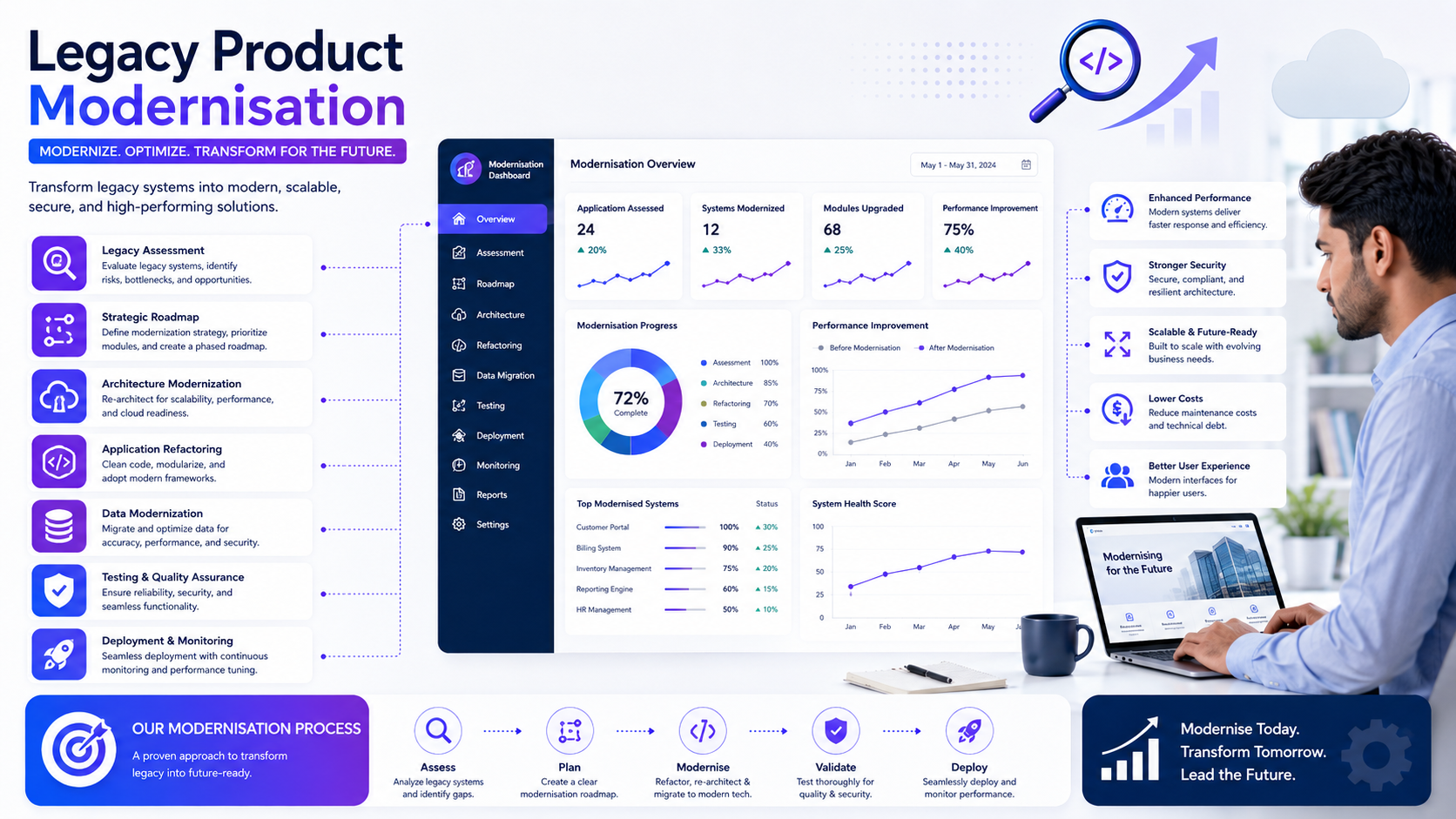
Legacy Product Modernisation
- Some startups begin with a prototype or early product that becomes difficult to maintain as the business grows.
- We can review the existing code, architecture and user experience to determine whether the application should be improved gradually, partially rebuilt or replaced.
- The recommendation is based on business impact, technical condition and migration risk rather than assuming that a complete rebuild is always necessary.
Ongoing Product Support
Ongoing Product Support
- A startup product continues to evolve after launch. Users may identify new needs, integrations may change and performance requirements may increase.
- We provide ongoing development, maintenance, monitoring, testing and feature improvement. Support can be arranged through a monthly development plan or a dedicated team model.
- This gives the startup continued access to technical expertise without immediately building a large internal development department.
From Broad Idea to Structured Product Plan
The discovery phase reduces uncertainty before the startup commits to full design and development — bringing business requirements, user needs and technical considerations into one shared plan.
Product and Business Understanding
We begin by discussing the problem, target users, business model, competitors and product vision.
We also examine how the startup expects to acquire customers, generate revenue and deliver the service operationally. A feature may appear useful from a user perspective but create an unrealistic manual workload for the startup team. Discovery helps identify such conflicts early.
User Journey Mapping
We map the steps different users will take inside the product. For example, a marketplace may include customers, service providers and administrators — each requiring different access, workflows and information.
Mapping these journeys helps reveal missing steps, unnecessary complexity and dependencies between features.
Feature Prioritisation
We organise features into launch requirements, later improvements and optional ideas, based on customer value, business importance, technical dependency and development effort.
Features that are visually impressive but do not support the central product experience are usually moved to a later phase, keeping the MVP focused and reducing avoidable development costs.
Technical Planning
Our developers review the expected functionality, integrations, data requirements and usage levels before recommending the architecture and technology stack.
The technical plan may cover application structure, database design, authentication, hosting, APIs, security, development environments and deployment — with any major technical risks identified before full development begins.
Wireframes and Product Prototype
Wireframes show how information and actions will be arranged on each screen, allowing the team to review usability before investing in detailed visual design or development.
For products with unfamiliar or complex workflows, we may also create an interactive prototype — founders can use it to demonstrate the concept to stakeholders, gather early feedback and test assumptions.
Scope, Timeline and Estimate
At the end of discovery, we provide a clearer development scope, recommended phases, estimated timeline and project cost.
This creates a shared reference for the startup and development team. Changes may still occur as the product evolves, but they can be evaluated against an agreed foundation.
Why Choose Rankraze for Startup Software Development?
Peace of Mind from Planning to Launch
Our structured development process gives founders complete visibility from planning through launch. You always know what is being built, the current project stage, and the decisions that require your input.
We explain technical concepts in clear business language, allowing you to make informed decisions without needing a software development background.
A Clear Scope Before Major Development Begins
Every project begins with a detailed discovery phase where we define user journeys, product features, technical requirements, and development priorities before implementation starts.
If requirements evolve during development, we clearly communicate the impact on cost, timelines, and functionality before any additional work begins.
Transparent Communication
We provide regular project updates covering completed work, ongoing tasks, potential risks, and upcoming milestones throughout the development lifecycle.
Open communication ensures founders remain informed, reducing uncertainty and allowing business planning to progress alongside product development.
Complete Product Ownership
Your startup retains ownership of approved deliverables, custom software, and source code according to the agreed project terms.
We maintain organised repositories and technical documentation so your product can continue evolving without unnecessary dependence on a development partner.
Development That Respects Your Budget
We prioritise high-value features and recommend phased development where appropriate, helping startups launch essential functionality first.
Our approach avoids unnecessary complexity, allowing you to invest in additional features only after validating customer demand and business growth.
Quality Built into the Process
Quality assurance is integrated throughout development with continuous testing, code reviews, version control, and staging environments.
This proactive approach helps identify issues early, improves reliability, and reduces the risk of costly last-minute fixes before launch.
Security-Conscious Development
We implement appropriate security practices including authentication, access control, secure communication, data validation, and dependency management.
Applications handling sensitive financial, healthcare, or personal information receive additional planning and security recommendations based on project requirements.
Scalable Technical Decisions
We recommend technologies and cloud infrastructure that match your startup's current stage while supporting future business growth.
Our goal is to balance cost, performance, maintainability, and scalability without introducing unnecessary enterprise-level complexity too early.
Ongoing Support After Launch
Launching your software marks the beginning of product growth. We continue supporting your application with monitoring, maintenance, and performance improvements.
Customer feedback, analytics, and market insights are transformed into prioritised development roadmaps that support future product releases.
Our Startup Software Development Process
Initial Consultation
We begin with a discussion about your idea, users, business model and current startup stage. The objective is to understand what you are trying to achieve and determine whether product discovery, MVP development, modernisation or another engagement is appropriate.
Discovery and Requirement Analysis
We document the main users, workflows, features, integrations and business requirements. The team identifies unknowns, technical risks and decisions that need to be resolved before development begins.
Product Scope and Roadmap
Features are prioritised and organised into logical development phases. The roadmap defines what will be included in the first release and what can be introduced later. It also creates a clearer relationship between the development plan, timeline and budget.
UX and Interface Design
Our designers create user journeys, wireframes and visual interfaces. Designs are reviewed before development so the startup can confirm navigation, content hierarchy and important interactions.
Software Development
The approved designs and requirements are converted into working software. Development is organised into manageable stages, with regular reviews and demonstrations. This allows progress to be evaluated throughout the project rather than only at final delivery.
Quality Assurance
The application is tested across supported devices, browsers and user roles.We examine functionality, validation, responsive behaviour, integrations and critical user journeys. Identified issues are documented, prioritised and resolved.
Continuous Optimisation
Campaigns are reviewed using search terms, audience behaviour, engagement, conversion rates and lead quality.Budgets, advertisements, keywords, landing pages and content priorities are adjusted according to performance. We also identify new opportunities as customer behaviour and market conditions change.
Deployment and Launch
The software is prepared for release in the agreed production environment. Deployment can include server configuration, database setup, domain connection, application-store preparation, tracking and final launch checks.
Post-Launch Support
After launch, we monitor the product, resolve agreed issues and support the startup during early usage. The next development priorities can then be based on customer feedback, support requests and product analytics.
Startup Industries Industries We Serve
Enterprise Software Startups
We build software for startups delivering operational, productivity, and management solutions for enterprise organisations. Products can include team accounts, role-based access, dashboards, reporting, onboarding systems, and third-party integrations.
Enterprise software often supports multiple decision-makers, making scalability, reliability, documentation, and security essential from the earliest stages of development.
Healthcare Startups
We develop healthcare platforms including appointment booking systems, patient portals, telehealth applications, wellness solutions, and healthcare workflow software.
Healthcare products frequently manage sensitive information, multiple user roles, and complex operational processes, requiring security, privacy, and usability from day one.
Logistics Startups
We create logistics software for delivery management, shipment tracking, fleet operations, route optimisation, driver applications, and customer communication platforms.
These products often depend on real-time data, location services, and external integrations while remaining intuitive for office teams and field users alike.
Insurance Startups
We support insurtech businesses with software for customer onboarding, quote management, claims processing, policy administration, and broker operations.
Insurance platforms often involve complex forms, documentation, calculations, and approval workflows that must remain efficient, accurate, and easy to use.
Ecommerce Startups
We build ecommerce websites, marketplaces, subscription platforms, and custom ordering systems with product management, payments, inventory, and customer accounts.
Our ecommerce solutions focus on creating seamless customer journeys from product discovery through checkout while supporting business growth and operational efficiency.
Real Estate Startups
We develop property portals, broker platforms, listing systems, tenant applications, and property management software tailored for the real estate industry.
Features can include advanced property search, interactive maps, appointment booking, lead management, document access, and property comparison tools.
Fintech Startups
We create fintech products including payment applications, accounting tools, financial dashboards, lending platforms, and business finance solutions.
Financial software requires secure authentication, reliable transaction workflows, regulatory awareness, intuitive user experiences, and robust third-party integrations.
Technologies We Use
We select technologies according to the product's requirements, expected usage, internal resources and future development needs. The best technology stack is the one that supports the product effectively without adding unnecessary complexity.
Frontend Technologies
For responsive web interfaces and interactive applications.
Backend Technologies
For application logic, APIs and server-side functionality.
Mobile App Technologies
Depending on the product, we may develop mobile applications using:
Databases
Selected based on the structure, volume and usage of product data.
Cloud and DevOps
For application deployment, infrastructure and monitoring.
Integrations
Connecting startup products with services such as:
The final stack is recommended during discovery after the product's functional and technical requirements are understood.
Startup Software Development Pricing
in London?
Product Discovery Package
Designed for founders who need to transform an early-stage idea into a structured and technically feasible product plan before development begins.
Product and business discovery workshops
Target-user and user-journey mapping
MVP feature prioritisation
Technical feasibility assessment
Wireframes for priority workflows
Recommended technology stack
Product development roadmap
Estimated development timeline and budget
Ideal for:
Early-stage startups, non-technical founders and businesses preparing to develop an MVP.
Startup MVP Development
Designed for startups building the first functional version of a web application, mobile application or SaaS product.
Product planning and requirement analysis
UX and interface design
Core frontend development
Backend and database development
Essential third-party integrations
Administrative dashboard
Quality assurance and software testing
Cloud deployment
Initial post-launch support
Ideal for:
Startups validating product demand, preparing a market pilot or launching a focused software product.
Growth Product Development
Created for funded startups developing an advanced application or expanding an existing MVP with additional functionality.
Advanced product strategy
Multiple user roles and permissions
Web and mobile application development
Complex third-party integrations
Subscription or payment systems
Advanced dashboards and reporting
Performance and scalability planning
Automated testing
Cloud infrastructure configuration
Ongoing product development support
Ideal for:
Funded startups, growing SaaS companies and businesses preparing to scale their product and customer base.
Dedicated Startup Development Team
A flexible engagement for startups that need ongoing access to developers, designers, quality-assurance specialists and technical leadership.The dedicated team can work alongside your founders or internal product department to build new functionality, improve existing software and support continuous product releases.
Dedicated frontend and backend developers
Mobile application developers
UI and UX designers
Quality-assurance specialists
Project coordination
DevOps and cloud support
Technical consultation
Sprint planning and product reviews
Ongoing maintenance and development
Ideal for:
Scaling startups, multi-product businesses and companies that require a long-term development team.
Package Information:
The final cost depends on the approved scope, user roles, platforms, integrations, security requirements, infrastructure and timeline.
Cloud hosting, paid APIs, software licences, application-store charges and other third-party services are generally billed separately. These costs are identified during planning wherever possible.
Projects can be delivered through milestone-based pricing, a dedicated monthly team or a phased engagement. The recommended model depends on how clearly the requirements are defined and how frequently the product is expected to change.
Frequently Asked Questions
Clear answers about CRM software and development services.
A startup software development company helps founders plan, design, build, test, and launch digital products. Services may include product discovery, MVP development, web applications, mobile apps, SaaS platforms, integrations, cloud deployment, and ongoing product support.
Yes. You do not need completed designs or technical documentation before speaking with us. Our discovery process transforms your idea into user journeys, prioritised features, wireframes, and a technical roadmap for development.
An MVP (Minimum Viable Product) is the first usable version of a product that includes only the essential features required to deliver its core value. It allows startups to validate ideas, gather customer feedback, and improve the product before investing in larger development.
A focused MVP typically takes around three to six months. The timeline depends on the required features, integrations, supported platforms, design complexity, and technical requirements.
The right choice depends on how your customers will use the product. Web applications are often suitable for B2B platforms and dashboards, while mobile apps are ideal when features like push notifications, location services, or device capabilities are required.
Yes. We build Android and iOS applications using both native and cross-platform technologies. The recommended approach depends on your business goals, performance requirements, budget, and future maintenance needs.
Yes. We can review your existing application, architecture, codebase, and user experience before recommending improvements, partial redevelopment, or a complete rebuild where necessary.
Yes. Ownership of custom source code and approved project deliverables is defined within the project agreement. Third-party frameworks, libraries, and licensed services remain subject to their respective licences.
Still have questions?
Get a free consultation and CRM strategy.